
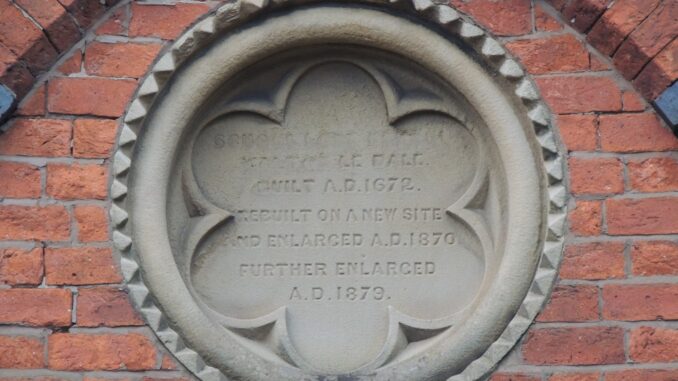
The Old Grammar School at Walton-le-Dale
THE OLD GRAMMAR SCHOOL AT WALTON-LE-DALE.
TO THE EDITOR OF THE PRESTON CHRONICLE. SIR, During the last month the condition of the school commonly known as the old Grammar School, at Walton, has been brought prominently before the public; first, at a meeting which was but meagrely attended, and secondly, at an adjourned meeting, held in the parish school-room, at which, I am informed, the attendance was still worse. Many people would be disposed, on reading the reports of these meetings in the newspapers, to ask, “What is it all about?” At both meetings the incumbent presided, and detailed briefly, but clearly, the present position of the school, and made some observations as to the low state of its funds. But so far as I remember, not a word was said in explanation of the predicament in which the matter stands, beyond this, that certain annual payments to the school had ceased, that a sum of money left by a gentleman had been lost, and that in consequence the school was either on its last legs, or had become closed altogether. No doubt these are circumstances sufficiently depressing to the good clergyman at Walton, and to the poorer part of his parishioners as well, but so far as I can understand the subject, there is nothing to justify the agitation which has been raised, and in my opinion it had been far better had there been no agitation at all. I read, the other day, a report of two sermons which had been preached on the previous Sabbath, at a Dissenting Chapel, near Blackburn, on behalf of the schools connected therewith, where the collections amounted to £150, sufficient, with the children’s pence, to pay a first-class schoolmaster and schoolmistress for a year, and this was contributed by one congregation only. In Walton-le-dale there are several cotton mills, exclusive of the concern at Moon’s Mill, the proprietors of which have done their share nobly towards the extension of church accommodation, education of the young, and so on. The population of Walton-le-dale, according to the census of 1861, is 7,383, the area in statute acres, 4,682; while the rateable value is £25,524. Suppose the people were voluntarily to raise, towards the maintenance of a schoolmaster and schoolmistress, one penny in the pound on this rateable value is £25,524. Suppose the people were voluntarily to raise, towards the maintenance of a schoolmaster and schoolmistress, one penny in the pound on this rateable value during the year, it would pay not only for a properly trained schoolmaster, but a mistress as well; or, put it in another way. Suppose the reverend gentleman, who is, I believe, the manager of the school, had special sermons once a year, the proceeds to be applied towards the stipend for the master, and suppose the inhabitants who send, or would send, their children thereto, should pay for each child a weekly sum, say 2d. or 3d., as the case might be, there is no question but this would be a sufficient stimulus to any master or mistress to bring it into a state of efficiency, and, in my opinion, would lead to its prosperity. I contend, that if a certain portion of the late Sir Henry Hoghton’s estate was chargeable with an annual amount to be devoted to the Walton school, it is either still so chargeable or it is not. The annual payment, as I understand it, is not repudiated by the present Sir Henry de Hoghton, only he is unable legally to ascertain his liability. Now, it is just possible that documents may not be discovered, which may throw more light on the matter than the report of the Charity Commissioners has done; and should law be produced to confirm what bas been merely usage, then surely the estate of the Hoghtons would be still liable for a yearly payment to this school. But apart from all this “higgling” and “haftling” about so paltry an affair, I am naturally drawn again to ask what is all the agitation about? Does it mean that a new room should be built?
Far better had it been, I think, to have appointed a certificated master at once, and applied to government for the usual grant, than to have set up so lachrymal a cry with which three-fourths of the inhabitants refused to sympathise. But the greatest blunder of all, as it seems to me, was that of deciding to open the place as a dame school. This I understand to be a school at which the ladies in the neighbourhood would attend in their turns, and so become mistresses for the time being. To this there can be no objection, so long as the school is confined to infants or children under five years old; but for boys and girls in their teens the plan would not work at all. Nor should it. I repeat it, there was no necessity for any agitation at Walton on the subject whatever. Perhaps it does not appear creditable to the respectable inhabitants, either, to have allowed the school to go down, or to have driven their minister to the alternative of exposing what it would have been wise to conceal. After this, public opinion as to the spirit or enterprise of the Walton people on behalf of the young, cannot run very high, and I am the more firmly convinced of this, when I consider that the ill-starred agitation which they got up was one of all others which could just as well have been managed privately, and perhaps with a good deal more satisfaction, readiness, and success. I should explain here, that I am no advocate for privacy where publicity is necessary; but in the case before me, if the matter of a really trifling sum a year could not be managed in a quieter manner than this school business was, then one-half of the private affairs of the Walton-le-dale inhabitants may next be publicly discussed. Talk of a paucity of numbers in attendance at the meetings already referred to! Why, the fact is, two-thirds of the people did not deem it worth their while to attend; and those who did, appeared for the nonce as fish out of water. After all, I do not forget the traditions and legends connected with Walton. It has been the scene of many a conflict between legitimate and lawless authority. It has been the rendezvous of men guilty of high treason, of noblemen forgetting or throwing off their allegiance, and dragging others into the net; men who were apprehended for their disloyalty, and who suffered death for it on the scaffold. So interesting a place, therefore, is the last in the world I should have imagined to be likely to trumpet forth the decay of its ordinary institutions, more especially its old school. Still, it would be nonsense to assert that in consequence of the school being closed, there was no spirit or taste in the village, for enter the place at three o’clock on the Saturday afternoon, which is
a kind of holiday, and you find,
Each blooming lass is proud to wear,
Her newest gown and bonnet,
While dames of threescore whisper near,
And moralise upon it.
Time certainly was, when the heads of the parish would not have allowed this school to go down, under any circumstances, for want of funds. But these worthies have passed away, and are no longer remembered. Still, on entering St. Leonard’s churchyard, we think of Gray-
Beneath these rugged elms, that yew trees’ shade,
Where heaves the turf in many a mould’ring heap,
Each in his narrow cell for ever laid,
The rude forefathers of the hamlet sleep.
I know that Walton was the birthplace of Henry Anderton, the temperance poet, who, like other natives of the village, has gone to his final rest. Walk into St. Leonard’s cemetery, and the sculptured stones remind you
That some village Hampden that, with dauntless breast,
The little tyrant of his fields withstood,
Some mute inglorious Milton here may rest,
Some Cromwell, guiltless of his country’s blood.
But it may be urged that I have been dealing with hypothesis, and that I have not treated the subject on its merits. Well, I can only say that I know that Walton school was at one time a model for such schools generally. The “turn out” at play time was more like the scene at one of our large grammar schools than that of a seminary in a rural neighbourhood. After all, from a moderate calculation, I believe that if the school was opened at once there are nearly one hundred boys, and as many girls, who would be sent to it, and whose parents are able to pay for their tuition. But this is not the first time the heads of the parish of Walton have created a mountain out of a mole hill. It is high time, therefore, that the people of “Walton proper,” or at least the prominent characters there, “turned over a new leaf.” Do they not possess a noble example in what Messrs. Rodgett, of Moons Mill, have done? They need not go far for such proofs of enterprize. It is surprising that it should have been stated at the meeting before referred to that only two gentlemen had promised to do anything towards revivifying the school, viz., Mr. Townley Parker and Mr. Charles Swainson, because I am convinced it only requires an effort to get up such a subscription annually as would place it for all future time on a solid foundation. I trust that the Walton people have sufficient independence to thank Mr. Parker for his kind offer, and at the same time to assure him that thyy are not at present disposed to tax the generosity of any gentleman living out of the parish for the support of an institution which they themselves are able and willing to attend to.
I believe the exposure respecting this school was the result of some hasty councils, and although it appears that, sooner or later, the state of the payments to it from old investments would have been disclosed, still it is questionable if the present can be called the proper time. I have no fear that, even if there be a doubt in the mind of Sir Henry de Hoghton, for instance, as to the liability of the family estate to pay a certain sum to the Walton school, he will give it the benefit of that doubt, and pay the amount annually, and thus add a lustre to the escutcheon of the Hoghtons, who have certainly never been wanting in their liberality to the parish, but, on the contrary, have shown their attachment to the place by deeds of benevolence, during many centuries.-Yours, &c.,
Preston, April 27, 1865.
AN OLD WALTONIAN.
CORRESPONDENCE.
Date: Saturday, Apr. 29, 1865
Publication: Preston Chronicle
Gale Primary Sources, British Library Newspapers:
https://link.gale.com/apps/doc/Y3207465727/BNCN?u=lancs&sid=bookmark-BNCN&pg=6&xid=479226fa
–