
THE HISTORIC SOCIETY
OF LANCASHIRE AND CHESHIRE.
ANNUAL EXCURSION.
On Tuesday, the members of this, one of the most flourishing of our local associations, enjoyed their usual annual excursion. The place selected for the visit was Preston, a town having many attractions. besides possessing within its immediate neighbourhood several spots highly interesting from their connection with those subjects which come more immediately within the sphere of the society’s operations. Independently of these considerations, the Liverpool society had received a very pressing invitation from many influential gentlemen of Preston to assemble there on the present occasion. The result showed that the selection was a most judicious one.
The arrangements for the accommodation of the numerous visitors were highly satisfactory, and all enjoyed a most delightful day. A party, consisting of the members of the Historic Society who proposed to take part in the excursion, assembled at the Exchange Station in the morning, by half-past seven o’clock. They numbered about twenty, and included the Rev. Dr. Hume, the honorary secretary, Mr. Danson, and several other gentlemen who take a prominent part in the society’s proceedings. The party reached Preston at a quarter-past nine, and were met at the station by Mr. Alderman R. Pedder, Mr. Alderman Brown, and other gentlemen.
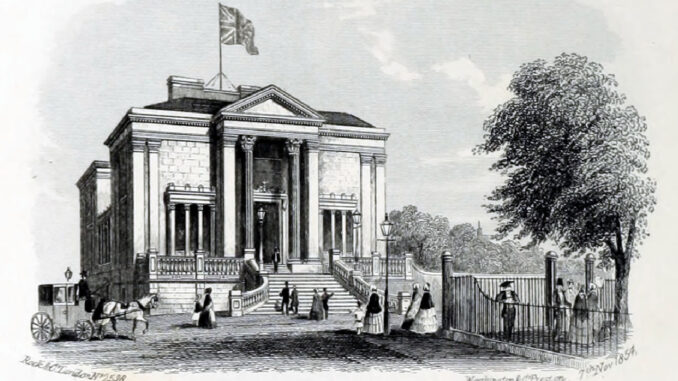
Thence they proceeded to the building known as the Avenham Institution, or “Institution for the diffusion of useful knowledge.” In order to gratify the visitors, a number of curiosities and antiquities, many of them of local interest, were exhibited in one of the large rooms of the institution. Amongst these objects were the insignia and plate of the Preston corporation, including there immense silver punchbowl, salver, and claret jug, presented to the municipal authorities nearly two centuries ago; several ancient records on parchment, a number of curious books, and some old staves, mounted with silver, used by a Jacobite club held at a remote period in Walton-le-Dale. There were a collection of ancient coins and some Roman pottery, being the result of researches recently made by Mr. C. Hardwick at Walton. These interesting relics were contributed chiefly by Mr. R. C. Townley, Mr. Dearden, Miss Ffarington, and other persons resident in Preston and the neighbourhood. After an inspection of these interesting objects, rendered more pleasing by the kind attentions and explanations of several gentlemen of Preston, assisted by the officials of the institution, the party were invited to an excellent dèjeûner, served up in the library in very excellent style by Mr. Howarth, of the Stanley Arms. Besides a number of ladies, there were present the following gentlemen of Preston:—Richard Threlfall, Esq., mayor; T. B. Addison, Esq., recorder; John Addison, Esq., county court judge; Alderman Brown; Richard Pedder, Esq., banker; Thomas Birchall, Esq., (Ribbleton Hall); Councillor Booth; Rev. Jolin Clay, Charles Cartwright, Esq.; Rev. Samuel Hastings; Rev. Chas. H. Wood; Wm. Howitt, Esq.; Rev. S. Ralph; Henry
Clark, Esq.; Ascroft, Esq.; William Dobson, Esq.; Robert Clarke, jun., Esq.; Rev. G. J. Piccop; Councillor Myers; J. J. Myers, Esq.; John Manchester, Esq. The following were amongst the Liverpool gentlemen:—J. T. Danson, Esq., F.S.S., vice-president of the Historic Society; Rev. Dr. Hume, secretary; Rev. Mr. Moore; Rev. Dr. Poggi; Wm. Rees, John Longton, David Buxton, Joseph Hughes, William Henderson, C. B. Robinson, and and T. B. Forwood, Esqs., &c. &c.
On leaving the institution the party proceeded in the first instance to an examination of the site where a number of Roman remains were recently discovered by Mr. C. Hardwick. Some time was spent in the examination of the spot, and several gentlemen brought away with them small articles which they purchased as reminiscences of their visit. The various objects of interest were pointed out and explained by Mr. Hardwick, who in April last read a paper on the subject before the Liverpool Historic Society. The discoveries throw considerable light on the probable stggestions that have been made from time to time that Ribchester was a seaport during the Roman occupation of Great Britain, and that the valley of the Ribble presents nearly the same features as at that period. According to tradition, the spot is said to be the burial ground of the Scotch warriors slain during Cromwell’s victory over the Duke of Hamilton, in 1648. On leaving Walton-le-Dale the excursionists returned along the margin o the Ribble to inake an inspection of Penwortham Priory, the church, and locality. Penwortham is about a mile from Preston, and is supposed to have been an ancient British station, which is partly shown by the etymology of the word. The priory probably existed in Saxon times, and is said to have been built on Roman remains. There one of the great Norman barons was stationed, to whom the Fleetwoods succeeded. The hill of Penwortham is a very commanding position, and probably served, as well as that of Tulcheth and Maudlands, for the protection of the priory. According to tradition, the hall was always called the Castle-hill, from the residence of Norman and Saxon barons on the spot, and this is considered highly probable from the various examinations that have taken place from time to time. The property belonged to the late Colonel Rosthorne, who purchased it from the Fleetwood family, the grantees previous to the period of the reformation;
and authority to excavate at the Castle Hill was obtained from his trustee, Charles Ledward, Esq., of Liverpool. The hill is conical, on the east bank of the Ribble, where it washed the Holms. It was considered probable that a Roman speculum had been erected on its peak, as it commanded such an excellent view of the newly discovered station of Walton-le-dale on the east and of Kirkham on the west. There are no remains of masonary on the summit of the hill, but it is conjectured that the speculum may have been of wood—a supposition highly probable under the circustances. The excavation of the hill was commenced on Monday, being undertaken by several gentlemen of the town and neighbourhood, under the direction of Mr. Willacy, the steward to the estate. In sinking the shaft, the excavators passed through a deposit, apparently natural, of the red sand of the neighbourhood, and then a silty of clay, underneath which was a large deposit of black peaty matter. Amongst the first were found the jaw bones of the wild boar, and portions of other animals not yet recognised. Along with these there was apparently a hand paddle of black oak, split up the centre. Little more was expected to be discovered, but yesterday, in a shaft near the peak of the hill, at a depth of nine feet, the workmen came to the same peaty material observed on the preceding day. At the bottom was a pavement composed of rude boulders, apparently the debris from the river, but laid in regular order. This was removed, and the solid marl then became visible. At the side round the excavation, about a foot and a half high, there was discovered a debris of vegetable and animal matter, and from this was taken, in the presence of the party, a skull of a small animal similar to the wild cat, part of the horn of the cervas elephas, and two horns of the bos. longifrons. A piece of crooked bone had evidently been cut by some metalic instruments, as if for the handle of a knife. There was a covering of wood, consisting of rafters squared, and in some parts charred, which had obviously been fixed with pegs, one of which was found. Over these was placed at right angles a bed of hazel rods of equal sizes, and on the top of them a bed of grass or rushes. The whole of these were pressed by the super-incumbent masses. Several conjectures were formed respecting their uses. It was supposed that the original geological surface of the hill still remained, and that the habitation had been cut out of the side of the hill. Part of it seemed a primitive seat of soil, 18 inches above the paved flooring. and the roof had been probably pressed in. This last supposition appeared probable, by the compressed top of the hill, and was thought to have formed a refuge of the ancient Britons, who had entered from the side, and that the Romans had afterwards used the hill for their own purposes. A large collection of bones and of wooden remains was preserved for future examination, amongst which were some berries of the ordinary sea tang. One of the gentlemen present, who had witnessed the whole of the explorations, promised to give a detailed account of the whole, and of similar remains, to the Historic Society, during the next session. Several of the party inspected Penwortham Church and some other objects of interest in the neighbourhood. It had been intended that one section of the excursionists should visit Ribchester, but this was abandoned from the want of sufficient time.
On returning from Penwortham, the members of the Historic Society and a number of gentlemen of Preston who had taken part in the proceedings of the day assembled at Mr. Millington’s, the Bull Hotel, where they sat down to a substantial dinner. The chair was occupied by R. Threlfall, Esq., the mayor of Preston, and the vice-chair by Alderman R. Pedder.
After the usual introductory toasts had been given, Mr. T. B. Addison called the attention of the company to the honour done to the inhabitants of Preston by the strangers who had favoured them with a visit. He referred to several of the sites which had been visited during the day, and entered into some historical explanations respecting them, expressing a hope that their Liverpool friends would pay them another visit. There were yet many other places in Preston and the neighbourhood worthy of their investigation. He thought the Historic Society must rank amongst those bodies which had prosecuted antiquarian researches with success, and it must be a high gratification to the Mayor and others present to have amongst them such visitors as they had on that interesting occasion. In conclusion, he proposed the toast of “Success to the Historic Society of Lancashire and Cheshire.” (Applause.)
The Rev. Dr. Hume, who was unanimously called for by the company, responded. He gave He gave a short sketch of the history of the Historic Society, and explained its leading features. He expressed a hope that their next anniversary meeting would be as pleasant as that which they had enjoyed, and thanked the gentlemen of Preston for their courtesy throughout the proceeding, the hospitality they had displayed, and the excellent arrangements they had made for showing the maximum of interesting subjects in a minimum of time. In conclusion he proposed “The health of his Worship the Mayor of Preston, and success to the ancient town which he so ably represented.” (This toast was drunk with three times three.) The Mayor briefly replied, and concluded by proposing the health of the vice-chairman.
The Vice-chairman acknowledged the compliment paid him. He proposed the healths of the ladies and gentlemen who had contributed so much to the interest of the day by sending objects of curiosity to the institution for the inspection of the visitors.
The toast was acknowledged by Mr. William Ashcroft.
Mr. J. Addison also offered some remarks, and was followed by the Rev. W. Thornber, who went at some length into the subjects which had come under inquiry during the day’s proceedings.
“The Health of the Visitors from Warrington” was given by Mr. W. Dobson, and responded to by Dr. Robson.
The visitors from Liverpool then retired, and returned from Preston by the seven o’clock train, having spent a most agreeable day, the gratification of which was much enhanced by the kind attentions of the gentlemen by whom they had been invited, and the able assistance rendered by the secretary of the society, the Rev. Dr. Hume.—Liverpool Mercury.
THE HISTORIC SOCIETY OF LANCASHIRE AND CHESHIRE
Date: Saturday, June 28, 1856
Publication: Cheshire Observer (Chester, England)
Volume: 3 , Issue: 112
Gale Primary Sources, British Library Newspapers:
https://link.gale.com/apps/doc/R3210274317/BNCN?u=lancs&sid=bookmark-BNCN&pg=5&xid=f3216907
~

~