
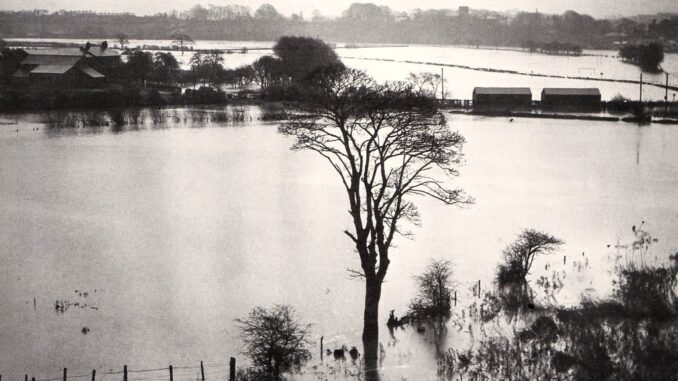
“…and the water in the principal street of the village could not be less that three yards in depth.”
GREAT DAMAGE BY THE FLOOD
AT WALTON-LE-DALE.
A MAN AND A HORSE DROWNED.
The immense flood of yesterday has been attended not only with much damage, but with loss of life. At an early hour yesterday morning the water had outstretched itself over the banks of the river into the lanes, and as far as the boiler fires at Messrs. Calvert and Son’s Mill, Walton village, and extinguished them. As stated in another column, the water at ten o’clock was rising rapidly, and was percolating itself through a strong wall opposite to the entrance of Calvert’s Mill. As time winded on, the river increased in magnitude, and about eleven o’clock the pressure of water against the abovementioned wall was so great that the wall gave way. Stones were scattered about in every direction, and the water rushed with fearful impetuosity into the road, and taking a direct line to the opposite side of the road, swept away the hedge separating a garden from the highway.
A portion of the north-west bank of the river Darwen, near to its confluence with the Ribble, gave way, and a rush of a dense volume of water over the large tract of garden land adjoining followed. In a very short time the whole of the gardens were put under water to the depth of at least two yards. The water, through the breach in the bank, flowed with great rapidity and in bub. bling streams across the whole of the gardens to the highway through the village, where it joined with the immense stream flowing over the banks of the Ribble in an opposite direction.
The conjunction of the two streets from opposite quarters rendered the road totally impassable near to the mill, and great danger was even attending an attempt to get from one extreme point of the inundated road to the other in vehicles. The current here was exceedingly strong; huge pavors were lifted out from the ground and cast for some distance further by the action of the stream. Large stones this morning are scattered about the road for a distance of fifty or sixty yards from the place where the wall stood. Hedgerows are torn up and carried away; railings are broken down and the water covers a great portion of the gardens. The footpath on the side of the mill is ploughed up in some instances to the depth of from three to four feet, and the ruts are filled with water. For about thirty or forty yards, the wall, with the exception of a portion in the centre of about two yards in breadth, has been completely razed, and the foot. path near it has been ploughed up to a considerable depth.
The embankment at this particular spot, for the greater part also gave way yesterday a little before noon, and a large number of flags lying thereon were either precipitated into the river or forced into the lane by the strength of the freshet. A number of pipes and portions of machinery, taken from the mill, to allow for the fixing of modern machinery, had been placed on a large quantity of loose cinders on the embankment, but these were forced along with the ashes to different positions. From the extreme point of the wall, a number of iron rails fixed in massive stone posts were undermined by the water, and forced from their holdings. Several of the pillars were smashed to pieces; in some cases the iron bars were bent, and wrenched from the stone posts; in others the posts were thrown on their sides, with the iron bars attached thereto standing erect. At this moment the pillars and bars lie in broken and confused heaps, and one of the large stone pillars, with a couple of bars fixed to it, lies several yards from its original position. The whole of the embankment for several yards has been swept away, and the flood, as we have already observed, rose alarmingly after ten o’clock yesterday morning, and the water in the principal street of the village could not be less that three yards in depth. As the inundation continued to increase the houses of the village became more deluged, and persons residing near the mill of Messrs. Calvert preferred to wade through the water and take up their situations in the higher stories of the mill than to remain in their respective domiciles. Those operatives who had no liking to wading through the great depth of water from the mill remained therein, and ultimately all means of egress or ingress to the factory was cut off by the expanding stream. The water continued to rise higher and higher, and the inmates of the mill to their chagrin were compelled to wait until the deluge should subside before they could leave.
GREAT DAMAGE BY THE FLOOD AT WALTON-LE-DALE.
Date: Saturday, Nov. 17, 1866
Publication: Preston Chronicle
Gale Primary Sources, British Library Newspapers:
https://link.gale.com/apps/doc/Y3207468942/BNCN?u=lancs&sid=bookmark-BNCN&pg=8&xid=3ad1847c
~
