
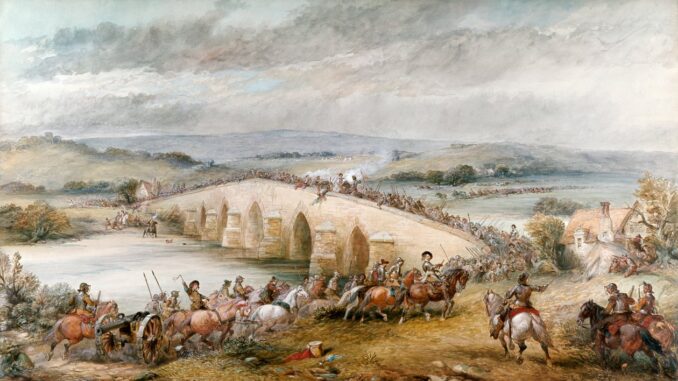
Destruction and Removal of An Ancient Relic
In August 1867, the Preston Chronicle published two letters protesting the removal of the last surviving fragment of the old bridge over the Ribble at Walton-le-Dale.
The five-arched bridge had been demolished in 1779–81 when the present bridge was constructed, but part of one of its piers had deliberately been left standing in the river as a tangible reminder of the ancient crossing. By 1867, it was regarded as a local antiquarian landmark, associated in the writers’ minds with Roman, medieval and Civil War history, as well as the Jacobite campaigns.
The relic was removed during works to improve the river embankment, apparently on the grounds that it interfered with the flow of the river. The correspondents vigorously disputed this justification and, more significantly, questioned whether a private individual had any right to remove what they regarded as a piece of public property.
Their indignation provides an intriguing early example of the Victorian concern for the preservation of historic monuments—and of the frustration felt when practical improvements were allowed to take precedence over reminders of the past.
~
DESTRUCTION OF AN ANCIENT RELIC.
TO THE EDITOR OF THE PRESTON CHRONICLE.
SIR,-Some improvements, I see, are being carried out in connection with the embankment of the Ribble, near to Walton Bridge, which, no doubt, will have the effect of rendering more secure the footing of the pedestrian, and of protecting the adjoining land from the ravages of winter floods. As the agent for the property, the work has been, I understand, under the superintendence of Mr. Hunt, of Frenchwood, to whom pedestrians will be much indebted for his attention to their comfort, apart from the consideration for the welfare of the adjoining property. So far as the embankment itself is immediately concerned, I have to congratulate Mr. Hunt on his thoughtfulness and success; but not so in another particular. By Mr. Hunt’s directions, I am informed, a part of one of the piers of an old bridge over the Ribble, near to the present one, has been removed from the middle of the stream. The old pier was linked with almost every historical event that took place within a period extending over many centuries, and it formed part of a bridge which had often raised contests for possession between the warriors in the civil feuds. Anciently, it was esteemed the greatest pass, in a military point of view, in the whole kingdom, and during the Jacobite rebellion particularly so, as it was then considered the most likely place for checking the inroads of the Scotch into the southern provinces. The last remnant of the old bridge has been deemed no longer worthy of a place in the bed of the river by Mr. Hunt, or some of his friends or assistants, on the ground, I am told, that the current caused by it would prove detrimental to the embankment in course of formation. This idea, in theory, may seem all very well, but, in a practical point of view, I cannot see much wisdom in it. The bed of the river in the immediate vicinity of the embankment is composed of rugged rocks, and at this moment the very spot tenanted for centuries by the old pier is bare, or nearly so, and must remain in this state until the river is swelled by a flood or a freshet. So far from diverging the water to the side of the embankment, the old pier could do no such thing at low water; if anything would do it, it would be the rugged bed of the river itself, and to obviate this the bed, to some extent, must be taken out. In a flood it would have little, if any, diverging influence, so as to injure the embankment, and it would just have been as sensible to pull down the piers of the present bridge, which are close by, in order to prevent any obstruction to the freedom of the water in its flow to the estuary.
But it is not with the embankment, or with the peculiarity of its construction, that I have to deal, but with the removal of the old pier. That relic was highly prized by many, and by Waltonians in particular, who, along with myself, are desirous of protesting against what they deem to be no less than a sacrilegious act. The old and the present bridges were, and are, the property of the public, and I, as a unit tending in some slight degree to compose that vast and important body, solemnly protest against either Mr. Hunt, or any other single individual, constituting himself a tribunal, and adjudging that that which belongs to everybody else, and which everybody else care for and reverence, shall no more exist. I look upon it as a daring and power-usurping act, and one which ought to call forth the condemnation of all who have regard for antiquities and memorials of the past. Had Mr. Hunt obtained per-memorial of a by gone age, I, as one of the community-as one of the numerous owners of those almost costless, but revered stones and mortar,-enter my veto against the usurped power.
Memorial after memorial of by-gone ages-reminders of valiant and heroic deeds performed by our forefathers, who slumber in the graveyard of the hamlet-seem to be vanishing day by day; and I think it behoves every one, not devoid of taste for antiquities, to see to them, and to prevent their desecration and obliteration.
By inserting this in your next issue, you will oblige, Yours respectfully,
Walton-le-dale, August 26th, 1867.
Н. В.
CORRESPONDENCE
Date: Saturday, Aug. 31, 1867
Publication: Preston Chronicle
Gale Primary Sources, British Library Newspapers:
https://link.gale.com/apps/doc/Y3207470403/BNCN?u=lancs&sid=bookmark-BNCN&pg=6&xid=d8824d51
~
REMOVAL OF AN ANCIENT RELIC.
TO THE EDITOR OF THE PRESTON CHRONICLE.
SIR, -Knowing your love for antiquarian matters, I venture to call your attention, and that of the public, to the removal of a relic several centuries old, in the river Ribble, near to Walton Bridge. There are but few persons, who have resided in Preston any length of time, but will have seen a huge rock, or a conglomeration of stones, cement, or mortar, &c., in the river near to the bridge just mentioned. This “rock,” as many no doubt are aware, was a portion of one of the piers of the bridge which spanned the Ribble previous to the erection of the one which now exists, close by. The erection of the old bridge dates far back in the annals of history, and, in the absence of any authoritative documents, supposition fixes it to have been of Saxon or early Norman construction. However near correctness the supposition may be, a bridge, consisting of five arches, existed in the time of Henry the Eighth, and is alluded to by Leland, the King’s antiquary, in his antiquarian collection. It appears, also, from a map published in Preston, in the year 1728, that a bridge then existed of five arches, so that in all probability the bridge spoken of by Leland exist centuries before his time, was the same as that in 1728, and the one razed on the construction of that which now crosses the river. The present bridge was built in three years, namely 1779, ’80, and ’81, at which time the old bridge just spoken of was wholly pulled down, with the exception of a portion of one of the piers, and that was left to mark the spot on which the ancient bridge stood. And very justly so; for upon it, and near to it, in by-gone ages, had many ferocious battles been fought, and many memorable scenes witnessed. Close to it was the ford of the Romans, and across it tramped the martial followers of Lord Hamilton and Oliver Cromwell, the armies of the Pretender and his son, and the royal forces. The “rook,” therefore, in itself possessed much interest, particularly to historians and lovers of antiquities.
It is now eighty-six years since the “rock” was separated from the rest of the material forming the five-arched bridge, and during that time it withstood many floods and tempests-yet still remained a pleasing reminder of many memorable events, an eye-sore to no one, a nuisance to no one, and an injury to no one. Last week but one, however, some one seems to have thought differently, and, anxious to serve some selfish motive, whilst void of any taste for relics of antiquity, he put his desecrating hands upon the “rock” and removed it-a lasting reproach to a selfish heart and despoiling hands!
Knowing your love, Mr. Editor, for relics of the past, I looked anxiously over your columns of Saturday for some notification of the removal of the “rock, and a spirited condemnation thereof, but in vain. I, therefore, feel impelled to offer a remonstrance against its removal, because 1 think I and others have a right to complain bitterly of such a work of demolition, I am not aware who it is that has laid sacrilegious hands upon this reminder of scenes in times past, but I should like to know, as would also, no doubt, many of your readers, by whom it has been re-moved, by what right it has been taken away, and by whose authority it has been shifted from the spot it had tenanted for centuries.
I apprehend-if I am wrong, I hope you will pardon me-that though the owners of land bordering on the river have a right to the fishery of the stream, yet they are not the owners of the stream itself. It is property be-longing to the public, the disposition, alteration, transference, &c., which is vested in the crown, and, if not in the crown itself, in the court of quarter sessions. The present bridge was, I believe, built at the expense of the public, at a cost of £4,200, in obedience to the orders of quarter sessions; the old bridge was pulled down at the expense of the public in consequence of orders from a similar quarter; and, if I am not greatly deceived, the ownership of the bridges, or any particle of them, is vested in the court of quarter sessions on behalf of the public.
The sanction, then, for the removal of the bridge, or bridges, or any portion of them, must be obtained, if jus-tice has to be done, from the public through their representatives in court of quarter sessions assembled. Has this been done? I think not; for I cannot persuade my-self to believe, that though we have sometimes some great mufties to represent us, the court of quarter sessions would be so careless for ancient relics as to give sanction to the removal of one without absolute cause. By whom, then, has it been removed, and by whose sanction ? If not by the court of quarter sessions, or by any other legalized authority, I would, had I the power, and I do really covet it at this moment-quickly bring the wretch, who would dare to destroy such loved relics, upon his marrow-bones, or bestow upon him such punishment as would teach him not to meddle with the like again. If such work as that alluded to is to be carried on openly and without question, all monuments, reminding us of past ages will quickly be swept off the face of the country. Can nothing be done to chock this! I think there can, if you, Mr. Editor, and others, will but use your great influence to obtain the preservation of them, and condemn their removal when absolute necessity does not require it. ‘Hoping you will give this a corner in your next impression, I beg to remain yours faithfully,
ROMANICUS.
Under the Arch, Ribble Bridge, August 22, 1867.
CORRESPONDENCE
Date: Saturday, Aug. 31, 1867
Publication: Preston Chronicle
Gale Primary Sources, British Library Newspapers:
https://link.gale.com/apps/doc/Y3207470403/BNCN?u=lancs&sid=bookmark-BNCN&pg=6&xid=d8824d51
~