
Dreadful and Revolting Outrages,
With Loss of Life.
The inhabitants of Penwortham and Farington during the night of Monday last, were placed in the greatest state of alarm, owing to a severe conflict having taken place, between some of the villagers and a number of the Irish labourers, who are employed at the North end of the North Union Railway, from Preston to Wigan, especially that portion of it in the neighbourhood of Farington School, about two mites and a half from this town. The conflict was of a very serious character, and as the sequel will shew, was attended by the most disastrous consequences. The following day, Tuesday, was employed by both parties in preparing for battle, and as night approached, the most serious results were apprehended. There are several hundred Irish labourers employed on the line. These labourers are paid fortnightly, and it has often occurred that the alternate Saturday nights, have been productive of scenes of intoxication and disturbance occasioned by these deluded men.
It would be gratifying to us, however, were we enabled to speak in terms of uniform praise, as regards the conduct of the villagers. In this instance, nevertheless, as far as we have been able to ascertain, in the neighbourhood, the Irishmen were the first to begin the disturbance, and that too, in the most wanton manner imaginable. Saturday last was the pay-day; but the disposition to tumult and violence on this occasion was not limited to a mere Saturday night’s row. On Monday evening between six and seven o’clock, two Irishmen, brothers, named Owen and Peter Deans, visited the house of an English cottager, a highly respectable and peaceable man, of the name of John Mayor, who resides at Farrington, in search of one of their countrymen, to whom they gave the familiar name of Barny Kelley, and not finding him there, they proceeded immediately to destroy all the furniture they could lay their hands The windows were dashed out, and the floor was strewed with the fragments of broken tables, the clock, crockeryware, &e. The Irish labourers had very generally dealt with a shopkeeper in Farington, and had been frequently suffered to get into his debt, but they were informed, on Saturday night last when they paid off their old score, that no further credit would be given, and the whole, except the two brothers. Owen and Peter Deans, paid their respective debts. It is conjectured, that the two Deans suspected Mayor of having advised the unexpected determination of the shopkeeper, and that they made the pretended search after their countryman a mere excuse for taking vengeance. Be this as it may, after destroying all within their reach, they retired to the Blue Anchor public-house, about half a mile distant, in the immediate neighbourhood of Messrs. Bashall and Boardman’s factory. At the Blue Anchor they found five of their countrymen in a lower apartment of the house. In an upper apartment there were about a dozen spinners from the factory, some accident from the machinery having liberated them from their work. After some conversation with each other, the Irishmen went into an adjoining yard, and breaking the gate, some pailings, forks. &c., armed themselves, and returned to the house. They then ascended the stairs in a body, and ordered the spinners to quit immediately. They did so, and retreated through the fields adjoining the house. Meanwhile, the Irishmen demanded of the landlady, Mrs. Fisher, a gill of ram; threatening, if she refused compliance, that they would tear the place down. The gill of rum was given them, but instead of drinking it, they placed it on the table and went in pursuit of the spinners, who, in the interim, had armed themselves with sticks and staves from the hedges; and who in their tarn repulsed their assailants.
Several broken heads were the consequence of this affray, and the Englishman retired across the fields to collect their neighbours and fellow labourers, in anticipation of a general assault from the Irish labourers on the railway. The beaten and enraged Irishmen returned to the public-house threatening vengeance as soon as they could collect their friends, and swearing that they would kill every Englishman that should fall in their way. On leaving the house they took the rum which they had extorted from the landlady on their previous visit. On their road towards Tardy Gate, and to the railway, they so inhumanly beat two men named William Miller, of Walton, and Richard Livesey, of Farington, that they are now lying, as we have been informed, med, in a very precarious state. The remaining part of Monday night appears to have been devoted both by the English and Irish to active preparation for the intended conflict on Tuesday evening; and nothing of moment seems to have occurred until the hands turned out from Bashall’s factory at half-past seven on Tuesday evening, when some hundreds of spinners and labourers went in a body towards the railway, cheering as they approached near to the Sumpter Horse in Penwortham, the head quarters of their opponents, and occasionally discharging, as it is said, in bravado, fire-arms with which several had provided themselves. The gangsman of the railway is a respectable elderly man of the name of Peter Smith, and lives on the line of road taken by the riotous mob. Our information does not enable us to state whether he was at home at the time or not, although it is unquestionable that his son Patrick was in the house, and is said t0 have fired from an upper window. This young man is about 28 years of age, and it was about the time when he is said to have fired that a man named John Trafford, a labourer, received a ball in his chest, when he staggered three or four yards and then fell dead, further particulars of which will be learned from the inquest reported below. A bloody rencontre succeded the death of this unfortunate young man; and it is computed that of English and Irish, from thirty to forty were more or less wounded; some heing shot, and others seriously injured, by blows from pikes, forks, clubs, &c. Peter Baxendale lies dangerously ill at the Sumpter Horse public-house, having three balls in his body; he is a married man with two chil dren. Lawrence Robinson, a young man eighteen years of age, is also at the same place; he had his arm shot through and his skull fractured, and is not expected to recover. James Almond, a man about 60 years of age, is also very seriously injured, by blows on the head and body. To these, with Livesey and Miller before mentioned, may be added a considerable number that aro slightly wounded. Two Irishmen are also seriously wounded, and are now in the House of Recovery. The magistrates of this town and neighbourhood assembled on Wednesday for the purpose of adopting some measure for the detection of the leading delinquents, and in prevention of a renewal of the disgusting and disgraceful proceedings it has unfortunately been our painful duty to record. The precise result of their deliberations have not yet transpired; out on Wednesday and Thursday a detachment of military from, we believe, Burnley barracks, paraded about in the neighbourhoods of Penwortham and Farington: but for their timely appearance it is more than probable that other breaches of the peace would have taken place. It is next to impossible to ascertain how many of the Irish are wounded, or to what extent, as great pains have been taken to conceal those who received injury. In addition to the names above mentioned, we have received the names of six more individuals, all we are informed in the employ of Messers. Bashall and Co., who were wounded by fire-arms.
William Wareing, shot through the hand; rather seriously injured.
Richard Wareing, shot through the thigh; rather seriously injured.
William Wilding, shot through the foot; rather seriously injured.
Richard Ashton, John Barrow, and Richard Richardson – slight. (slightly injured)
This article was written before the holding of the inquest: it will be we subjoin a full report, that the points here alluded to were cleared up
THE INQUEST.
On Thursday an inquest was taken at Mr. Wilding’s, the Sumpter Horse public-house, Penwortham, before R. Palmer, Esq., on the body of the unfortunate deceased, John Trafford, then and there lying dead. The inquest seemed to excite great interest in the neighbourhood, and a great number of persons were waiting anxiously in the vicinity of the public-house. Colonel Rawstorne and Mr. Mc. Mahon were in attendance. The following were sworn on the jury:-Mr. Brown, foreman; Thomas Alty, William Breakell, Thomas Smalley, Robert Mayor, Nic. Knowles, John Walmsley, Jas. Crook, R. Beardsworth, James Taylor, Thomas Livesey, John Miller, Thomas Moon, Robert Smalley. The following was the evidence taken:-
Thomas Sims, blacksmith, of Walton-le-Dale said, I knew the deceased, who was a labourer, and might be about thirty years of age. On Tuesday last, about eight o’clock in the evening, the deceased came up to me and said, “What dost thou think about this stir.” I said I doubted it would be a rough stir. He said, “I will go and watch them,” and he then left me. The number of persons assembled in the lane near to Tardy Gate, might amount from three to four hundred; some of them were armed with guns, others with sticks of various sizes, some with hedge-stakes, and some with other weapons. The people assembled in the lanes were shouting and huzzaing. Among the crowd of persons I saw Lawrence and Thomas Robinson, of Farington, but when I saw the two Robinsons, neither of them had any weapons. The deceased was not armed with any weapon.
Robert Norris, of Penwortham, labourer, heing sworn, said, on Tuesday night last, between nine and ten o’clock, I was going towards Farington from Penwortham, and when I got near to the place where the railway crosses the road, in Farington, I met a great number of persons, to the number of about one hundred; I saw that two of the persons had guns.
I turned back with them, and when wo got to Tardy Gate, the party were joined by a great number of persons, who might amount to two or three hundred at the least. The party then camo on to Penwortham, and got as far as a house occupied by Peter Smith; after they had passed the house about thirty yards, the crowd turned back to go to their homes.-
When they were passing Smith’s house, I heard the breaking of some glass, and then the report of a gun I saw Patrick Smith standing at the window, in a room up stairs, with a double-barrelled gun in his hands. I then saw him Gre tho Bun, and I heard its report; I turned my head and saw two men laying on the ground, at a distance of about ten yards from the house. I did not know either of the men laying on the ground. I was frightened and ran away. Before I heard the two reports of guns, I heard some reports of guns that were fired by the mob in front of Smith’s house. I have said it was Pat Smith who had fired, and I only thought it was him because it was his house.
The Coroner enquired if Patrick Smith was present?
Mr. Me. Mahon said he was in Preston, but should be sent for.
Dr. Norris entering the room at this time, was requested by the Coroner to examine the body of the deceased, but a difficulty occurred in consequence of the violent interposition of the father-in-law of the unfortunate deceased, who opposed the examination of the body, by any medical gentleman. Dr. Norris having left the room,
Robert Norris was then cross-examined; he said that his only reason for saying Pat Smith tired the guns from the window was, that he knew he lived there.
Dr. Norris again entered the room, and stated that he had been unable to ascertain the direction of the wound, in consequence of the continued determined opposition of the father-in-law.
The learned Coroner immediately directed the police to re-move the body by force. Colonel Rawstorne accompanied them for the purpose of superintending the removal of the difficulty, which was eventually effected, despite the opposition of several men collected in front of the house, who abetted the irrational resistance of the old man.
Joseph Thornber, of Preston, railway constable, deposed;-On Tuesday last, a little past eight o’clock at night, Thomas Hilton, another railway constable, and John Patten, the con-stable of Farington, and myself, were together, and in consequence of certain information which I had received, wo went to the Blue Anchor, in Farington, near to which house wo found from twenty to thirty people assembled together; wo went up to them, and desired them to go home, and told them that persons were not allowed to stand together in such numbers: the persons did not use any violent language, nor had any of them any weapons with them. In a few minutes after-wards they were joined by other persons coming in different directions. Some of them were armed with guns; others with pitchforks from six to eight feet long; one had an old seythe, and another a bill-hook; a quantity had deal timbers, with pikes at the end, about six inches long. I advised them to go home. There were about seven or eight hundred persons together; a great part of whom were boys, from eight to eighteen years old. Some of them appeared to have something concealed under their jackets, and one of them allowed me to take a carving knife from him to examine it; it was about eighteen inches long, and did not appear to have been used; it was newly ground, and was sharpened at the back. I stepped up to a person whom I believed to be the ringleader,
and whose name I believed to be George Robinson; I desired him to go back, and he said, “No, we are not willing, we have
received so much injury from the Irish, that we are determined to have revenge.” Some of the crowd cried out “Do not
stop for two constables.” Robinson had a gun, and carried it perpendicularly; I believe there were upwards of fifteen guns
among them; I was fully of opinion that they were determined to come forward, and Hilton and I retreated; I then saw the
mob go towards Penwortham. In about ten minutes after the ob had passed me, I heard the reports of the firing of seven
or eight guns from the direction the mob had taken. From information which I received, myself and Hilton came forward to
Penwortham, and betwixt the Bee Lane end and the lane that leads to the engine used for the railway, I found the deceased
John Trafford, lying in the ditch, with his face downwards.
I turned him over, but he did not speak; there was a gurgling in his throat, and he appeared to be dying. I left the deceased
lying there; there was no other body lying nearer to that of the deceased than fifty-four yards, at which distance I found a
person named Basendale, who told me he was shot in the back. I then retuned to Trafford, and found that he was
dead. The distance between Smith’s house and the place where I found the body of Trafford, is ninety-two yards. I
returned to Baxendale, and there were a number of Irishmen round him, and one of the persons called out “Dama him, his
eyes are bright yet. 1 desired them to be quiet, and so did Patrick Smith. Patrick Smith said he would shoot the first
nean that harmed Baxendale. Smith had a gun in his hand at the time. About ten yards from Basendale, I saw William
Robinson laying on the ground; his face was bloody, and a quantity of people were round him with a lantern. Among
the number whom I believed to be Irishmen, many of them had black thorn sticks; others had cudgels, and one of them
had a piece of iron about two feet long. The people soon after dispersed. The place where Baxendale was found was
thirty-eight yards from Smith’s house, and where Robinson lay was twenty-eight yards.
Dr. Norris, of Preston, being examined, said; -On Wed-nesday morning last, about half-past one one o’clock, ‘I saw the de-ceased lying at Penwortham, and he was then dead. I ob-served a wound in the upper part of the chest; it was a ragged wound, of a circular form. I have this day made a post-mortem examination of the body; and the wound ap-pears to have been occasioned by a gun shot; the wound was apparently too small and irregular to have been produced by a ball, but might have been produced by a slug, such as I subse-quently found in another part of the body; it had perforated one of the large blood vessels, proceeding from the right tung to the heart; the immediate result of the injury would be a great effusion of blood into the chest, and death in a few mi-nutes. It is possible that the deceased might have walked a few yards after receiving the injury. On the left side of the chest, there was a wound similar in external appearance to that 1 have deseribed. I found that it had been occasioned by a sing which I now produce. There was also a superficial gun shot wound in the right arm. It is my opinión that all these wounds might have been produced by a single discharge from one gan. The immediate cause of the deceased’s death was the wound I first described.
Thomas Hilton, of Farington, railway constable, deposed;-I have heard Joseph Thornher’s examination read over, and it is generally correct. I was with Thornber on that night du-ring the time that the affray happened. I saw Patrick Smith with Basendale, but I did not see that he had a gun in his hand, as stated by Thornber. Smith was using his best enden-vours to proteet Baxendale, who was then lying on the ground. John Potter, constable of the township of Farington said: I was in Farington on Tuesday night, and saw a great number of persons assembled tegether, armed with guns and other weapons, and going towards Penwortham, and in about twenty minutes after I heard the report of about twenty guns, to the best of my belief.
On George Gray, engineer of Penwortham, examined. Tuesday night last, ubout nine o’clock, I was in the dwelling-house of Peter Smith, of Penwortham. Peter Smith, Pat Smith, his son, and William Birley, the constable of Penwor-tham, were also there. I was in a rooni up stairs, fronting to the road, and I saw a great number of persons pass the house, and immediately after they had passed, I heard the report of a gun. In a short time afterwards, I heard the report of two or three guns, and heard people passing the house while they were passing, several stones were thrown, and part of the win-dows of Smith’s house were broken, the stones came into the room. As near as could be, after the windows were broken, I saw Pat Smith, who was in the same room, fire with a double barrelled gun through the window, but I was so agitated that I cannot say whether he fired the gun more than once, or whe-ther Le fired both barrels at once, or in what direction the gun was pointed. At the time the mob was passing the front of Smith’s house the first time, they were shouting and huzzaing, and some one cried out, “shut the window, or we’ll lire.” I remained in the house of Smith, till all was quiet, being apprehensive of personal danger.
George Man, “waggon breaker” examined: I was standing on Tuesday night last, about nine o’clock, and as the nob were passing, I heard several of them cry out “shut the windows, or we’ll fire.” In about four or five minutes afterwards, I saw a gan fired towards Smith’s house; the gun was fired by some person in the lane; the shot passed just above my head, and I then retired behind the house. There was silence for a few minutes, and I then heard some one call out “fire;” immediately afterwards I heard the report of three or four guns, but being behind the house I could not see in what direction they were fired.
John Fitzpatrick, overseer of Penwortham examined: On Tuesday night last, between nine and ten o’clock, I was stand-ing in company with about twenty or thirty or forty of our people, near the road at Penwortham, at a short distance from Peter Smith’s house. I saw a great crowd of persons coming towards Smith’s house, shouting and hazzaing. Robert Robinson was one of the persons, and when he came right opposite Smith’s house, he called out, Put out your lights, now you soft devils stand, and we’ll drive the whole of them (meaning the Irish,) out of the place or country.” After Robinson and the party along with him had passed Smith’s house about twenty yards, Robinson called out to them, “fire.” I saw the flash, and heard the reports of three guns, which were fired in the direction of Smith’s house. In about a minute afterwards two other guns were fired, and one of them wounded Wm. Cassidy in the arm. Wm. Cassidy was stand-ing with me and other persons near Smith’s house. I heard several other shots fired, but I cannot say how many. In about ten minutes after the firing ended, I found two men lying upon the ground, a little above Smith’s house. Pat Smith was then protecting them, and said that no man should meddle with them. Smith at that time had not any gun with him. None of the Irishmen had any guns with them, but about forty of them had sticks.
Patrick Quin was examined, but his testimony was nearly a reiteration of that given by the last witness. William Birley, constable of Penwortham, examined;-On Tuesday night last, about nine o’clock, I was standing near Tardy Gate, and I saw five or six hundred persons assembled together, and coming towards Penwortham. I think about a dozen of them were armed with guns; one of them had a pitch fork, another a seythe, and many others had bludgeons. Lawrence Robinson and Robert Robinson were among the crowd; Lawrence had a short club, and I told him he was well tackled; he said “What has thou to do with it?” some one called out, “Damn you, you soft devils, go on.” The crowd then passed on, and I went towards Penwortham, and told the railway people to get out of the way. I then went to Peter Smith’s house, and we heard the crowd huzzning; at Smith’s request I went into his house to protect it, and the door was fastened after me; I went up stairs into the front room, but the crowd having then come up with a great noise, I was alarmed, and went into a back room, to be out of the way of danger, and immediately afterwards I heard the report of a gun; I also heard the smash of windows, and soon after heard Patrick Smith ask if there was any powder. The crowd passed Smith’s house, and I then got out of the house and saw the crowd coming back. I got near to the ditch side, and some one in the crowd cried out to me, “Tell your name, or we’ll shoot you.” I said, it is Birley the constable, and I was then told to pass on. I waited nearly opposite to the Sumpter Horse, while the crowd was returning, and I counted the reports of seven guns very near one after another, but it was dark, and I could not see which way they wore shooting. After the crowd had gone, I saw two men lying upon the ground, who were wounded, but not dead, they were about eight or ten yards asunder. The name of one is Robinson, and the other Baxendale; they lay at a distance of about thirty or forty yards from Smith’s houses I got a lantern, and found the deceased lying partly upon his back near to the road side; he was at the distance of from ninety to a hundred yards from Smith’s house; he appeared to be dead, and was soon after-wards removed to the Sumpter Horse.
The Coroner then made enquiries, in order to ascertain whether there were any other witnesses who wished to give evi-dence. No one however appeared, and the jury were also asked whether they could suggest any further evidence; an answer being returned in the negative, the learned Coroner read over and lucidly summed up the evidence. He carefully pointed out to the jury the different poluts requiring notice, and stated the law upon the rospective questions which pre-“sented themselves during the examination. The jury, having consulted together for about ten minutes, returned a ver-dict of “Manslaughter against some person or persORS BR-known; they also aquitted Smith of being at all implicated in the death of the deceased.
The inquisition occupied nearly eight hours.
A man named Lawrence Wilkinson, who was wounded in the affray at Penworthata, died yesterday.
DREADFUL AND REVOLTING OUTRAGES, WITH LOSS OF LIFE.
Saturday, May 26, 1838
Publication: Preston Chronicle
Gale Primary Sources, British Library Newspapers:
https://link.gale.com/apps/doc/Y3207416280/BNCN?u=lancs&sid=bookmark-BNCN&pg=3&xid=29c8d887
~
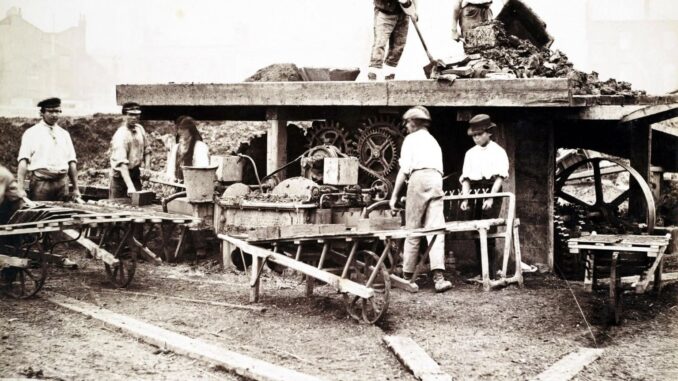
There were no photographic images from the time (1833), so the photograph used in this post is of “Navvies using a brickmaking machine during the construction of the Midland Railway’s extension to St Pancras station, London, 29 August 1865.”
This image is courtesy of the National Railway Museum, which is part of the Science Museum Group.
https://www.railwaymuseum.org.uk/objects-and-stories/navvies-workers-who-built-railways