
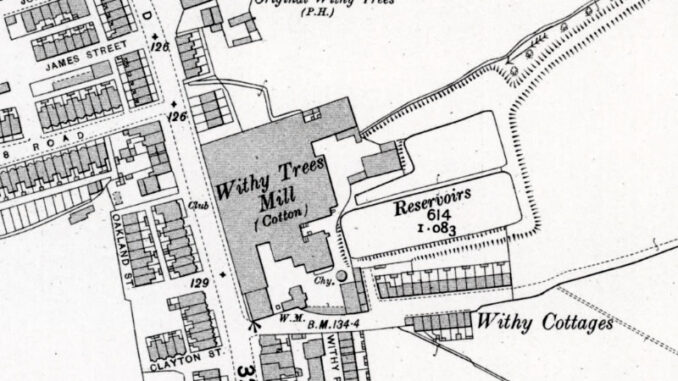
DESTRUCTION OF A FACTORY DY FIRE. On Tuesday morning last, before day-break, the factory of Messrs. Thomas and William Eccles, spinners, at the Withy Trees, (three miles from this town on the Chorley road), was totally destroyed by fire. The flames were first observed about half-past one o’clock, issuing from a lower window of the engine-house, which formed the south side of the building, and as the wind was from that direction, and blowing briskly, the upper part of the factory soon caught fire, by the roof and the apertures in the separation wall.
At a quarter to two, fire partially burst from the slates and the whole of the upper floors were soon afterwards in a blaze. By this time not above twenty persons had assembled, amongst whom was Mr. William Eccles, one of the proprietors, who was called from his house in the neighbourhood; but the alarm being given, nearly two hundred persons were soon collected, anxious to give every assistance where it could be available. A horse was immediately dispatched to Preston to procure engines, and in the meantime numbers of cans were procured, and the people exerted themselves to the utmost under the direction of Mr. Eccles, to prevent the spread of the devouring clement. Abundance of water was procured from the lodge close by, but the rapidity of the conflagration was such that all hope of saving the southern portion of the premises in which alone the spinning had hitherto been carried on, were soon at an end, and every effort was directed to the saving of the adjoining new and more lofty and extensive building for the extension of the works, which has but recently been roofed in, and which was in a state of forwardness for the reception of machinery. Parties mounted to the roof of this building, two stories higher than the portion which had caught fire, and continued to throw down water to prevent the division wall from so heating as to ignite the timber on the other side. These exertions, although a comparatively small quantity of water could be carried in cans, were of good effect, and were, there is no doubt, the means of saving the north part of the premises. The flames meantime raged with uncontrollable fury in the factory before three o’clock the roof and upper floor fell in with a tremendous crash; the next floor had not yet fallen, but the weight of the materials together with that of the machinery, carried the other floors to the ground and filled the whole of the interior with one mass of flame -so intense that it could not, in several directions, be approached. Even at this fearful juncture, several of the men remained firmly at their posts in and on the new building, the top of the staircase of which (in an outer angle) was already on fire; and amongst others who were severely scorched with bearing water, was a slater, whose shirt was partly burned from his back, and his hair singed from one side of his head. About half past three, one of the town’s engines (No. 2) arrived, drawn by the horse which had been sent to Preston, and which was ready to drop down from exhaustion. Soon after another engine was brought to the ground. These were stationed on the east side of the premises, and began to play upon the fire, but the smoke and combustion from the cotton and timber was such that their effect was not for some time perceptible, and every thing in the old factory being already destroyed and irrecoverable, they began and continued to play upon the partition wall of the new erection, now less exposed by the shifting of the wind, and towards six o’clock the flames having nearly consumed whatever was within their reach, no further danger was apprehended. These buildings are entirely of stone, and as the wall timbers or stringers are nearly all burned and the window-stones and walls split and mutilated by the heat, the whole of the south end may be considered as destroyed, together with the valuable machinery that had been in use, and also ten pairs of new steam-looms, two patent Dyer’s frames, and other valuable articles intended for the new works. Had the wind which was from the south, and drove the flames longitudinally through the factory, not luckily shifted to a westerly direction, all the exertions made would have been unavailing to ve the new building; as it was, many of the new timbers became ignited, and the flames penetrated the roof of the new stair-case. In what manner the fire originated it is not known, but it appears certain that it first broke out in the engine-house, in which several mechanics were at work packing the engine till within a quarter to twelve o’clock on the same night. They state that they extinguished the light which they had used, which was inclosed in glass; and that all appeared to be safe when they closed the doors. Mr. Eccles does not attach any blame, to these men, and it is conjectured that some latent combustion must have previously existed in or about the engine-house from which the accident arose.
Mr. E., who though greatly distressed, was indefatigable, and happily successful, in his endeavours to save the remaining property, had himself a narrow escape. He fell through one of the unboarded floors of the new building to the floor below, but luckily received only a few bruises on the thighs, which did not prevent him from persevering in directing the people, of whose whose activity and good good will on the occasion he speaks in the highest terms. When the fire was at its height, it is represented to have been awful and sublime the flames roaring high above the buildings and illuminated the country far and wide. At one time Mr. Snell, of the firm of Snell and Co., manufacturers, of Bamber-bridge, was apprehensive that his dwelling-house, which is not far distant, would take fire from the brands which, borne aloft by the flames, were showered in every direction; but no other injury to property took place.
Some burning materials were picked up half a mile distant on the Preston road. The factory on the following day presented nothing but naked and dilapidated walls, and the interior was filled to the depth of several feet with fine wheels, spindles, shafts, and other machinery, smashed to pieces or injured beyond repair by the action of the fire. The engine, which appeared to be from 20 to 22 horse-power, suffered comparatively less injury-owing to the wind blowing the flames from it to the interior of the works; but it is not yet ascertained what injury it has received, or whether it is worthy of being refitted. It was truly lamentable to see so large a quantity of fine and minute iron and brass work, produced by a vast exertion of labour and ingenuity, thus whelmed in destruction. We under-stand the premises were insured, but not nearly to the extent of the property consumed, and the proprietors will, therefore, not only be great losers, but several hundreds of individuals hitherto employed at the works, will necessarily be thrown out of employment. It is, however, extremely fortunate that the new building was saved, as it may probably be fitted up, so that operations may be resumed as early as possible. Besides the spinners, a considerable number of joiners, masons, and other mechanines, are in the meantime deprived of work by this unfortunate accident.
PRESTON, SATURDAY, SEPTEMBER 24, 1831.
Date: Saturday, Sept. 24, 1831
Publication: Preston Chronicle
Gale Primary Sources, British Library Newspapers:
https://link.gale.com/apps/doc/Y3205332075/BNCN?u=lancs&sid=bookmark-BNCN&pg=3&xid=dba67ac4
~