
Walton le Dale | A History of the Village
by Frank Coupe
(under the patronage of the Walton-le-Dale Urban District Council)
Publication date: 1954 | Publisher: Guardian Press
(link below)
~
~
PREFACE
a literary HISTORY, in whatever form, proffers to the author a adventure sufficient for many years; but an adventure worth-while. To read, verify and compare the works of past historical writers is truly fascinating and an absorbing study.
My chief concern in producing this book was to see that, as near as possible, it must be free from error, and no effort has been spared by me to attain that elusive perfection. It is unnecessary to mention the many difficulties which arise, and occasionally a confliction of statement met with in ancient documents; but by careful analysis, through comparison, one is brought within reach of the evidence and knowledge sought.
Whether it be ancient history, ecclesiastic architecture, or appreciation of scenic beauty, I claim no esoteric knowledge, my only desire has been to convey to my readers the story in a simple and intelligible way. Certain passages may appear to have a confusion of dates, but this is unavoidable even when the matter is chronologically collated.
Since this book is confined exclusively to the village of Walton-le-Dale it does not imply that other villages in the Urban District are devoid of history, but to embody the complete story in one volume would have been very unwieldy and an immense task. A completion of the work is, however, within the range of possibility.
The reason why this work has been undertaken was to convey, without egotism, an historical record of the village of my birth. Innumerable documents, historical works, ancient records and maps have been searched in an effort to achieve my purpose, and it is with a feeling of deep gratitude that I present to my readers a publication which would not have been possible to compile without the help and suggestions so freely given by my many friends.
Each chapter has been revised by a person fully qualified to deal with it, and it is only fitting that these should be acknowledged separately. Their kindness and help to me has been invaluable and is much appreciated.
FRANK COUPE
WALTON-LE-DALE,
1954-
~
INTRODUCTION
HAVING been born in Walton-le-Dale and lived in the village all my life, I have a great love of the district. When Mr. Coupe asked me to write an introduction to his book, I accepted with pride but with a feeling that my knowledge of the history of Walton-le-Dale was very limited.
To introduce a book of this nature calls for a personal knowledge of the author, and this I can safely say 1 have, also of the many interests which he has at heart.
Few people realise, among them myself, the true historic age of Walton-le-Dale, and to write a history covering over two thousand years is proof of the author’s deep interest in his native village.
There are many places in these islands that have age-old connections, and many now are merely grassed-over relics of the past, and village life has long since disappeared; but here we can boast of over two thousand years of almost unbroken history. Even before the Norman Conquest a most important event occurred in the District of Walton-le-Dale, namely, the discovery of the Cuerdale treasure. Several important finds in recent years have brought to light other features of local history. The Roman camp along the bank of the Darwen, year by year reveals objects of great interest, but so far the extent of this Roman camp has only just been touched. In years to come it is hoped that a full story of the camp will be revealed.
The history of the Civil War and the rebellions make a thrilling story.
In a work of this nature it is always uppermost in the author’s mind that it is essential to be as near accurate in detail as possible, and I know that Mr. Coupe has devoted countless hours in his search for knowledge; hours, too, which have been of enjoyment to him in his love for the district.
This book, I am convinced, will be of immense value now and in the years to come, both as a source of information and as a living record of our village history.
P. H. PARKER
IVY COTTAGE, WALTON-LE-DALE, 18th October, 1954-
~
Internet Archive
This book can be read online via something known as the Internet Archive. It is free to use and there is much information to look at and in some case download.
It has many old library books that have been digitised and uploaded for people to read. This one, like all the other is free to view. However,
1) It can’t be downloaded
2) It can only initially be ‘previewed’
You need to sign up to view the book, but it is free to do this. It’s a while since I did it, but I don’t remember it being difficult.
.
A History of the Village by Frank Coupe (1954):
.
https://archive.org/details/historyofvillage0000fran/page/n3/mode/2up
.
H. Hartley
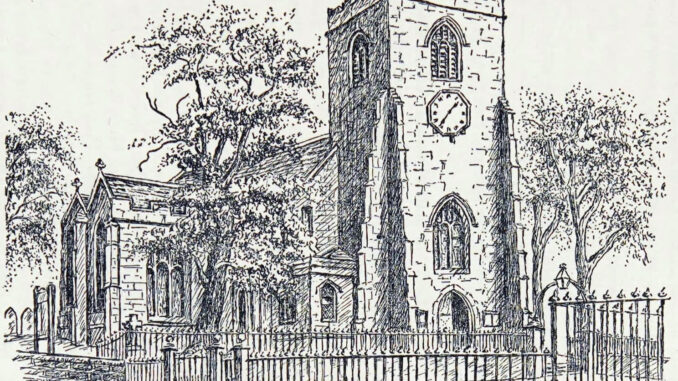
The drawing of St Leonard’s Church is from the book and was drawn by H. Hartley in 1947.
He was brought up in Red Lion cottage, next to the Church.
Served in the First World War, was a joiner, stone mason and a talented artist.
.