
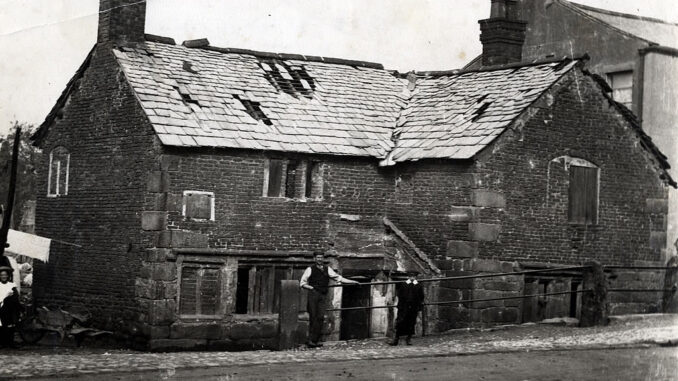
This building was captured on several photographs and had been painted on a number of occasions. It was referred to by one of the artists, Edwin Beattie, as the Halfway House. He gives a more specific title of the ‘Halfway House between Edinburgh and London’, which suggest that it may have been some kind of Coaching Inn. Sadly, in its latter years, it fell into disrepair and was demolished shortly after it was last photographed in around 1900. It appears to be at a lower level than the surrounding buildings, which suggests that the level of the road has risen by a fairly significant amount over the years, and the newer building were built the newer road level. Chorley Road in that location was originally known as ‘Walton Cop’.
Other historical references call it the ‘Jacobite House’. It is referred to that in Frank Coupes 1954 book about the history of the village. What is strange, with regard to his book, is that there is a photograph with a caption saying, “Jacobite House – Chorley Road”. However, it doesn’t appear to be mentioned in any of the books written passages. There is no history of this building given.
On the next photo, it can be seen beside The Queens Arms Hotel circa 1900. Here it really does appear to be at a much lower level than the adjacent building. After the Jacobite House & Hotel were demolished, the site was occupied by Fred Coupes Motor Garage. There is some time between the two demolitions. The Jacobite house was gone, whilst the Queens Arms building was still standing at the time of the 1909 Ordnance Survey map. However, it was no longer marked as a pub did not appear in any subsequent directory records.

More information about The Queens Arms Hotel can be found in the Chorley’s Inns and Taverns Blog. This Blog is, as the name suggests, primarily about the Inns, Taverns, Pubs, Hotels and Beer Houses of Chorley (Lancashire). Although, there is a lot of information about establishments in what the author describes as, ‘its outlying villages’. This means that there are pages for many historical establishments that are in the current South Ribble Borough.
Read the Chorley’s Inns and Taverns Blog:
https://chorleyinnsandtaverns.blogspot.com/p/walton-le-dale-queens-arms.html
Edwin Robert Beattie
Edwin Robert Beattie (1845–1917) painted the building in 1891. As per the opening paragraph, he referrers to it as ‘Halfway-House, London to Edinburgh, Walton Cop, Walton-le-Dale’. The painting is currently in the possession of the Harris Museum & Art Gallery, latterly known as just The Harris.

Why it should be referred to as the ‘Jacobite House‘ in other places is unclear. It may have been used by ‘Jacobites’ and the village does have connections to the Jacobite Rising. The Jacobite Rising of 1715, also known as ‘the Fifteen’, was an unsuccessful attempt by Jacobites to restore the Catholic Stuart dynasty (James Francis Edward Stuart, ‘the Old Pretender’) to the British thrones after the Protestant Hanoverian George I took power following Queen Anne’s death. The last Battle on English soil took place in Preston as part of this uprising.
It is not clear on any of the photographs, but Beattie has made a point of painting the datestone details. It seems that the building may have been constructed in two phase from that. There are dates of 1663 & 1685. In both case the dates are accompanied by initials, but they are not clear. “D” and “T R” is a definite possibility for the 1663 date, but the initials with the later 1685 date are ambiguous. The “D” & “T” seem to be present again, but there are two more symbols that I cannot distinguish.
The Halfway-House, London to Edinburgh, Walton-le-Dale by Edwin Robert Beattie (1845–1917), can be seen on the ‘Harris Museum & Art Gallery’ section of the Art UK website:
https://artuk.org/discover/artworks/halfway-house-london-to-edinburgh-walton-le-dale-236802
John Ferguson (active 1834-1862)
The following information was supplied by Martin Read who responded to a call in the Preston History Facebook group for information about the life and works of local artist John Ferguson. He was born in the Fishwick area of Preston, a part of the town which produced several local artists. The date of his birth is uncertain but was probably in the first decade of the 19th century. The Fergusons were an old Preston family but as far as one knows, not necessarily artists, at least not professionally. His name first appears on a prospectus advertising the Preston Society of Arts, September 1834. This suggests he must have been well established as a painter by this date. The earliest available trades directory has him living at 8, Spring Vale in Oxford St in 1841 where he is listed as a portrait and landscape artist.
There is evidence to suggest that (like Beattie) he “re-produced” certain views, for instance on the original of Half-Way House on close inspection it can clearly be seen that there are extra horses legs pencilled in. This may be due to tracing through from a master copy then just altering the legs for variety, equally so he might just have changed his mind without rubbing out the unwanted legs.

On this photograph, it is described as a Jacobite House on Chorley Road, Walton-le-Dale. The property was demolished in the early 20th century.
