
OUR COUNTRY CHURCHES AND CHAPELS:
THEIR PAST AND PRESENT, WITH VIEWS OF THEIR CLERGY AND CONGREGATIONS.
(BY “ATTICUS.”)
WALTON-LE-DALE CATHOLIC CHAPEL.
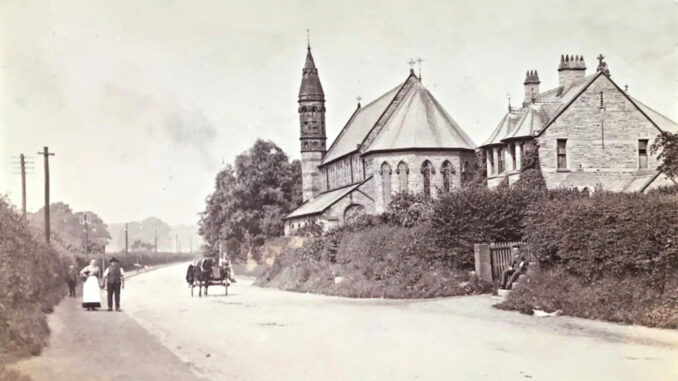
Perhaps 350 yards on the eastern side of the village of Walton-le-Dale, 15 yards beyond that very substantial sounding hostelry-the Beef Steak Inn, and closely adjoining the high road running between Lower and Higher Walton, there stands the plain little Catholic Chapel of St. Patrick. Its position is very low; but its surroundings are pleasant. Resting upon the hill above it there is the grey old church of Walton, looking ever so dignified and picturesque; before it runs the stream of the Darwen, passing on to the sea with a slow murmuring cadence; and higher up there is Darwen Bank nestling contentedly amid thick olden foliage, and reminding one more of some antique classical grove than of a nineteenth century residence, with a look out, as it has, upon nearly 100 cotton factories. St. Patrick’s chapel at Walton, was neither designed nor built for a place of worship. It is really a school, but is used for divine service, because the means are not at hand for a properly constructed chapel. No place requires such a chapel more than Walton; and we have authority for saying that all contributions, how ever microscopical, will be thankfully received, for this purpose, and that large sums will be accepted with special cheerfulness. There are about 1,000 Catholics in the district of Walton, and some of them belong to very old families. One of them is associated with the knightly house of the Southworths, who once held Samlesbury and its ancient hall; and others, allied with Catholics dating far back, might, if it were necessary, be named. The Catholic chapel of Walton, is quite of modern date. The nucleus of the present mission was formed not many years ago. A club room in the Grove Inn originally constituted the Catholic chapel of the district, and a small building adjoining, at one time used as a stable, was its school. If this was not beginning at the bottom of the ladder, we should like to know where the bottom of that said ladder is. On the 29th of June, 1857, the foundation stone of the present school chapel was laid, by the Rev. Father Smith, of Brindle, who was the originator of the mission. He is of the O.S.B. order, which, according to the “O.I.S.E.” theory, may be thus translated-“Order of Saint Benedict;” and the mission at Walton was established under the auspices of, and is now in connection with, that section of the Catholic Church. On the 20th of December, 1857, the building was opened, and of its kind it is a very good one; but with this serious drawback, that it stands too low, is exceedingly damp at times, and is liable to be flooded in some parts, owing to the backwatering of sewers, when the Darwen is “out.” In one of the lateral portions of the building there is generally, in wet wintry weather, two or three feet of water, and this, by even the most teetotal members of the congregation, is objected to. The chapel-we will give it that name for the sake of shortness and simplicity is nearly out of sight: it is flanked with houses, the aforesaid Beef Steak Inn doing its share in the work of obnubilation-we recommend that word to the kindly consideration of the proprietor; it is fronted by houses, the chief one in the row being that in which the resident priest fives Aves; and it is not by any means in the right place for such a building. In external appearance it is very mildly ornamental-is of Gothic design, with various side gables, &c. The building is of brick, with stone facings, and if not very elaborate it is as an edifice fairly substantial. Beyond it, and running clear up a very steep hill, there is the burial ground. A large stone cross occupies a position near the centre of it, and on each side of the front there are numerous graves, kept in creditable order, and having in many cases neat, substantial head stones. The burial ground is about one statute acre in extent, was opened on the 29th of May, 1861, and prior to that time was called, “Monks’ Meadow;” the inference being that it was formerly part of the abbey lands of Whalley, and was in some way associated with the Cistercians of that place. At the top of the burial ground in the north western corner-there is a nice space of ground, which would serve admirably for the site of a church; the ground being dry, and the position most commanding. This, and not the damp, hidden hollow at the base of the ground, is really the place for such a building; and it could be approached with comparative ease by a winding road on the south eastern side. There is a fine view of the scenery of the district from the high ground we have just mentioned. The valley of the Darwen stretches out quietly in the foreground; far away. up, and rising with a clear dark line against the horizon, the brow of Hoghton Tower appears; whilst in the opposite direction, to the west, the woodland scenery of Penwortham, curiously relieved, at rapid intervals, with long level lines of steam from passing railway engines, fills up the land-scape. The whole of the land belonging to the mission, including the burial ground, a plot on one side of it, and that upon which the chapel, &c., stands, is about three statute acres in extent; and the entire sum spent thus far upon it may be set down at about £2,800, of which sum about 21,300 remains unpaid. The chapel, when you enter it by the principal door on the eastern side, has a very long, narrow, and somewhat shadowy appearance; and it is quite clear, when you look at the opposite wall, that there are some attending the place who are either very excellent sleepers or very fond of hair oil; for the wall is dotted with black marks made by people leaning their heads against it, and the effect, if not artistic, is at any rate clear and striking. The building has an open pointed roof, 30ft. from the floor to the apex; is 103ft. long; 18ft. broad; and will accommodate about 800 persons. The walls are plain, and are pierced on the eastern side with five strong windows filled in with heavy opaque glass. In the roof there are several dormer windows of a triangular shape; but owing to their smallness, they do not throw much light into the edifice. There are three and twenty ventilators in the building, and if they do not keep up a correct temperature for the people, and give a proper sup-ply of oxygen to them, then their case is rather desperate. The sanctuary at the northern end looks dull and plain; but then it is only an improvised affair; was fitted up at the beginning in a temporary style style; the idea being, that so long as it was only intended to serve until something better could be obtained, that as the building would ultimately be set apart entirely for what it was originally intended-a school-and that as a church would in the end be substituted for it, there would be little wisdom in making its embellishment anything very costly. The altar is, under the circumstances, neat looking; it is backed by a moderately decorated wall, is surmounted by a framed painting of our Saviour, and flanked by statues of the Virgin and St. Joseph. There are two services, morning and afternoon, at the chapel on a Sunday, and the average attendance at each will about 250. The congregation consists entirely of working people, including a very considerable sprinkling of young females, rather largely enamoured of roses, feathers, and captivating head-gearing. But all who attend, young and old, appear to be a very orderly, devout class, and, considering their means, they assist very creditably and liberally the mission to which they are attached. The members of the choir have their quarters in a diminutive gallery, at the far end of the chapel. Four of them-females-sit on one side; and three of them-males-on the other; whilst the central part is taken up by the organist. The singing of the females is very creditable; and that of the other members is good, but it is defective in power. The organ is a good one, but it is fixed too low down-is partially buried-and this operates against the fullness and clearness of its music. It is played by an elderly gentleman with ever so much taste; but both would look more imposing, and acquit themselves more excellent, if they were “a little higher up in the world.”
There have been four priests stationed at the mission since it was opened; their order being as follows: Rev. Fathers J. Proctor, W. A. Fleming, J. Carroll, and J. E. Poole. The last named gentleman is the present resident priest, and he has been at the place nearly three years. Father Poole is a small, active, industrious priest; is sharp in temperament, red in hair, humble in spirit, earnest in promoting the interests of his district, a hater of dear gas-thinks 6s. 5 d. per 1,000 for it in Walton an awful thing; has worked vigorously for the mission, and reduced its debt considerably; has the organ of wonder largely developed; often says “my word” by way of exclamation; can’t be inactive; must be doing something, or thinking about something for the benefit of the place; has no pride in him; believes oysters are nutritious; and is much thought of by his flock. He was born at Liverpool in 1819; studied at
Ampleforth College, in Yorkshire; was ordained in 1845; began his clerical life as second priest at Warrington; then went to Whitehaven; then to Maryport; and came to Walton-le-dale in February, 1868. He is a good preacher-not eloquent, not very rhetorical in style, but full of sense plain and Christian charity. He makes long pauses in the earlier portions of his sermons; seems to be thinking much about the matter; holds his hands well before him; then increases in speed; opens his hands a little; increases still more in speed; gets his hands released; and eventually speaks out rapidly, energetically, pointedly; and, on the whole, preaches very practically.
He is quiet, homely, and sociable in the outer world; and never gets into “hot water,” though always a Poole. There are day and Sunday schools in connection with the mission, and the work of them is conducted in a portion of the chapel buildings, under the excellent supervision of Mr. Joseph Turner, the master. The average week-day attendance is about 60; and on Sundays it ranges a little above that figure. The schools are in a very fair state of efficiency; and during this generation and the next there need be no fear-taking the entire buildings into consideration of defective accommodation. The mission wants church and not school facilities; accommodation for men and women rather than for juveniles; and if Father Poole could only live to see the day when he had a church at the top of the hill he would be happy, even if gas were 10s. 6d. 1,000, and bivalves, however nutritious they may be, had
gone to sleep in their own native beds for ever.
OUR COUNTRY CHURCHES AND CHAPELS.
Date: Saturday, Dec. 17, 1870
Publication: Preston Chronicle
Gale Primary Sources, British Library Newspapers:
https://link.gale.com/apps/doc/Y3207476348/BNCN?u=lancs&sid=bookmark-BNCN&pg=6&xid=90eaccf2