
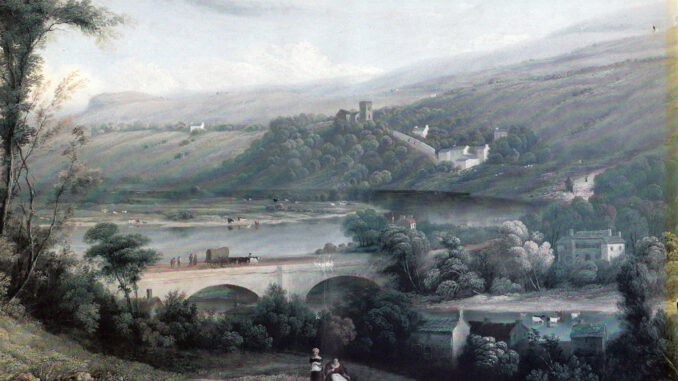
Walton le Dale from Preston by Anthony Devis circa 1800
A photograph of a print of a landscape painting by Anthony Devis (1729-1816), found in a charity shop by ‘Middle Ford Miss‘ in November 2011.
Anthony Devis (1729-1816)
Anthony Devis (1729, Preston, Lancashire – 26 April 1816, Albury, Surrey)
Anthony Devis was an English landscape painter and drawing master, born in Preston into a family with strong artistic connections. His elder half-brother, Arthur Devis (1712–1787), became a prominent painter of small portraits and informal “conversation pieces”, and Arthur’s sons, Thomas Anthony Devis (1757–1810) and Arthur William Devis (1762–1822), also pursued professional artistic careers.
An entry in the Preston Guild Roll for 1742 records that Anthony Devis was already working as a painter in London by the age of thirteen, having apparently moved there with Arthur and his other older half-brothers. He began exhibiting in London in 1761, typically showing works titled simply A Landscape. Despite the generic titles, he is known to have received commissions from patrons with estates across Wales and many regions of England.
By the late 1750s, Devis had begun producing landscape views of northern England, including works associated with the Lake District. Among these is the large oil painting View of Derwentwater and Skiddaw from Lord’s Island, now held by Abbot Hall Art Gallery in Kendal. Although the details of his travels are undocumented, he produced a substantial number of drawings characterised by a lively and distinctive handling. Known subjects include scenes in Borrowdale, the Bowder Stone, Bowness, Furness Fell, Langdale, the Langdale Pikes (with Blea Tarn), and Rydal Head (with Loughrigg and Elterwater). Many of these drawings are topographical in nature and are sometimes annotated with place names. Alongside such works, Devis also produced imaginary or idealised landscapes in the manner of the Old Masters, often described as capricci.
From 1762 onwards, Devis lived in Bloomsbury, first in Gloucester Street and later in Lamb’s Conduit Street. In 1780 he purchased Albury House, near Guildford in Surrey, where he eventually retired. His date of death was long uncertain, but it is clearly recorded on his tombstone in the churchyard at Albury: 26th April 1816.

The painting is apparently listed as being in the possession of ‘The Harris’ (The Harris Museum and Art Gallery). The book ‘British and Irish Paintings in Public Collections’, has it listed as:
Walton le Dale from Frenchwood List 1990 inv.no.P1791.
British and Irish Paintings in Public Collections
An Index of British and Irish Oil Paintings by Artists Born Before 1870 in Public and Institutional Collections in the United Kingdom and Ireland
By Christopher Wright, Catherine May Gordon · 2006
https://www.google.co.uk/books/edition/British_and_Irish_Paintings_in_Public_Co/9XNe0mLSJQAC
.

The perspective of the painting seems a little strange, compared to what you might capture on a camera today, but it’s perhaps not as inaccurate as it first seems. The height of the hills in the top right portion of the painting seem exaggerated. There wasn’t much in the way of buildings in Walton le Dale compared to today. The artist was stood in the Frenchwood area to the south of Preston, looking to Walton le Dale over the River Ribble.
- Houghton Tower – The building can’t really be seen, but the ‘mound’ it sits on
- Knot House – is still there today
- St Leonard’s Church – is slightly more obscured by trees today
- Red Lion inn – is now houses
- Highwood – some of it is still there
- Cooper Hill – was demolished in the 1950s
- Toll House – is gone, the White Bull in the approximate location
- 31, Victoria Road – is a guess, but very possible and would explain why it is set back
- Bridge Inn – Sadly was demolished for the Day Care Centre
- Ribble Bridge – or ‘Walton Bridge’ was built in the 1780s, but was later widened
By the time detailed and accurate maps of the area had been made in the late 1840s, approximately half a century later, the landscape had already changed quite considerably.