
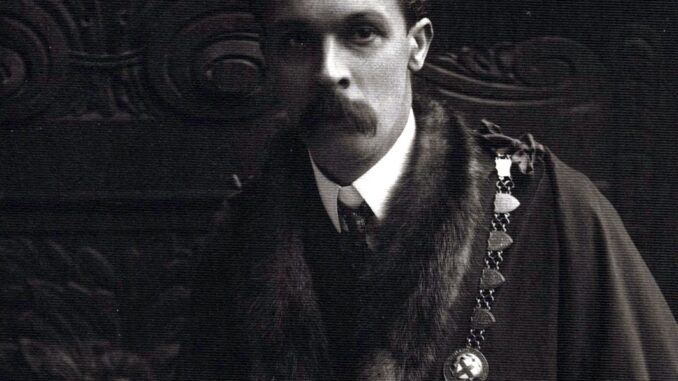
The Ryder Cup, Born in Walton-le-Dale
The Ryder Cup has become one of the world’s greatest sporting events. Every two years, 24 of the best golfers from Europe and the United States go head-to-head in match play competition. It encompasses drama, tension, incredible golf, camaraderie and sportsmanship. They are all served in equal measure, captivating an audience of millions of viewers around the world. It’s an event that transcends sport, yet remains true to the spirit of its founder, Samuel Ryder.
Samuel Ryder was born on 24th March 1858 in Walton-le-Dale. He was one of eight children of Samuel (senior) who was a gardener and Elizabeth who was a dressmaker. The family later moved to Sale, near Manchester, and Samuel Senior’s gardening business then expanded considerably.
Originally intending to become a teacher, Samuel enrolled at what would later become Manchester University. However, his constitution was not strong enough for the long periods of intensive study that this required. He subsequently took a position at a local firm of shipping agents, before joining his father’s market garden business. Soon after, Samuel senior was honoured with membership of the Royal Horticultural Society.
After a number of years in his father’s business, Samuel came up with a novel idea in horticulture. He noticed that the general public were being priced out of taking an interest in gardening. He thought that by selling penny packets of seed through mail order, he could make it affordable for ordinary people to take a pride their gardens. He set up his business in St Albans. Following in his father’s footsteps, Samuel also became a member of the Royal Horticultural Society.
Although being interested in sport from an early age, in particular cricket and rugby, Samuel’s health had never been good, so that limited his chances of participating. In later life, he became a councillor and, after just two years on the council, his fellow councillors selected him to be the Mayor of St Albans. Sadly, his spell as the mayor tired him considerably. To reinvigorate him, his church minister persuaded him to get out into the fresh air and enjoy a round of golf. At the age of 49 Samuel Ryder started playing golf.
Later, as a means of advertising their business, and to support golf professionals at the same time, Samuel and his brother James staged a series of professional competitions. Their first tournament, which was in 1923, used the title of their firm ‘Heath & Heather’. It attracted the cream of British golf including six Open Champions.
Whilst Samuel was playing holiday golf in Dorset with club professional Ernest Whitcombe, Ernest remarked to Samuel, “The Americans come over here smartly dressed and backed by wealthy supporters, the Britisher has a poor chance compared to that.” That comment seemed to touched a raw nerve with Samuel. He decided that something special was required to rouse the golfing community into taking a real interest in encouraging young professionals of talent like the three Whitcombe brothers – Ernest, Charles and Reg. In an article in the Herts Advertiser, during June 1924, they quoted Samuel Ryder as saying the firm of “Heath and Heather were contemplating challenging the Americans to a match.”
Samuel’s innovative efforts were finally rewarded when he donated a gold cup for the first official Ryder Cup match in 1927 between teams representing Great Britain and America. A sports event of world-wide significance had been launched.

The inaugural Ryder Cup competition took place at Worcester Country Club, Worcester, Massachusetts, USA, on 3rd and 4th June, 1927.
The US Ryder Cup Team elected to field a team of native-born Americans at the first formal match. The British Team sailed on the Aquitania from Southampton, a six-day journey for the competition at Worcester Country Club, which featured four foursomes and eight singles matches. The Americans won nine matches, with only two defeats and one half. Ted Ray, a then British professional golfer, later summed up the initial matches saying, “One of the chief reasons for our failure was the superior putting of the American team. They holed out much better than we did.”
~
Samuel Ryder’s Life in Walton-le-Dale
At the time of the Ryder Cup event taking place in 2025, somebody pointed out in a post on the Preston Past & Present Facebook group, this year’s competition started today. There had been some discussion about this topic on a Walton le Dale (private) Facebook group. Somebody posed the question about how to go about getting a Blue Plaque to commemorate Samuel Ryder’s birth, and the time he spent in Walton le Dale. However, we haven’t yet been able to quite pin anything down.
A member of the Walton-le-Dale Facebook group looked Samuel Ryder up on the ‘Ancestry‘ website. They commented that if the date of birth is definitely 24/3/1858 & mother Elizabeth, then his baptism is recorded as taking place within a “Primitive Methodist Circuit” on 10th April 1858. They thought that it could perhaps be the old chapel at bottom of Church Brow in Walton-le-Dale. However, the Wesleyan Chapel in Walton le Dale is dated 1881.
By 1858 the Wesleyans had been active locally for over a century – John Wesley himself preached in Preston from the 1740s, and by the 1760s there were already class meetings in places like Cockshott House in Walton-le-Dale. From that point of view, when the baptism record mentions the “Primitive Methodist Circuit” it’s definitely not the later Wesleyan chapel on Church Brow that was built 1881. It makes reference to being part of a much older network of societies and meeting places that pre-dated purpose-built chapels.
The first established chapel, to my knowledge, was the one in Bamber Bridge. Sadly, the building was demolished circa 2004, but the Methodist presence remains. This would have been in the Walton le Dale area at the time. Walton le Dale was an ancient parish in its own right, and its vestry would have overseen those local civil functions. The most likely construction period for the Wesleyan chapel on Wesley Street is the mid 1850s to 1860s. However, there is no firm evidence to support this (yet).
Something that I had never considered before, but the Methodist Church is on Wesley Street in Bamber Bridge. I probably previously thought that this was taken from a local person’s name. However, it seems likely that the street name was influenced by the Wesleyan Methodist presence there.
Before, we can consider a ‘Blue Plaque’ or similar, I suppose that it would be necessary to ascertain a definitive birth location.

~
Sporting Ryder Cup Gesture by U.S.

DONOR NOT IN FAVOUR OF AMERICAN PROPOSAL.
Open Champion Unable to Play for Britain.
GOLF SURPRISE.
MR SAMUEL RYDER, the donor of the cup which is bi-annually contested by the professional golfers of Great Britain and the United States made a sensational declaration, yesterday, when he said that he was not in favour of the United States Professional Golfers’ Association’s suggestion that Ryder Cup qualification should be one of birth and not residence.
Unless Mr Ryder changes his mind this means that Great Britain will be deprived of the services of Henry Cotton, the British Open champion, probably the greatest golfer in the world to-day.
Mr Jacobus, president of the United States P.G.A., has intimated in a letter to the British P.G.A. that America is willing for a change in the deed of gift whereby birth and not residence would be the necessary qualification.
“It would be ridiculous,” says Mr Jacobus for the British to send a team without Cotton, so I have written to them suggesting that they suggest Mr Ryder changes the deed of gift. We have assured them that the U.S.P.G.A. heartily approves of such an action.”
No Alteration.
Mr Ryder told a reporter in London, yesterday: “I do not agree with an alteration in the deed of gift. If an exception is to be made, let both sides agree to it. An alteration would mean that Syd Brews for instance, who is resident in South Africa, would be eligible for Great Britain, for he was born at at Blackheath.”
Mr Jacobus the American president told Reuter that the Ryder Cup match would positively not be held in October, as suggested by the British Association.
“It will be either just before or just after the American open championship in June,” he said.
The newspaper article, Sporting Ryder Cup Gesture by U.S.
Date: Wednesday, Nov. 28, 1934
Publication: Western Daily Press (Yeovil, England)
~
Further reading and sources of information
The Samuel Ryder Foundation – About Samuel Ryder
http://www.sryder.com/about-samuel-ryder.html
.
Ryder Cup History – The Ryder Cup Official Website
https://www.rydercup.com/history
.
Ordnance Survey map showing Wesley Street in Bamber Bridge (1910)
https://maps.nls.uk/geo/explore/side-by-side/#zoom=18.2&lat=53.72529&lon=-2.66011&layers=168&right=ESRIWorld
.
Ordnance Survey map showing the Wesleyan Chapel in Walton-le-Dale (1910)
.
Sporting Ryder Cup Gesture by U.S.
Western Daily Press via Gale Primary Sources, British Library Newspapers
https://link.gale.com/apps/doc/EZ3246143958/BNCN?u=lancs&sid=bookmark-BNCN&pg=3&xid=a1c0406d
.