
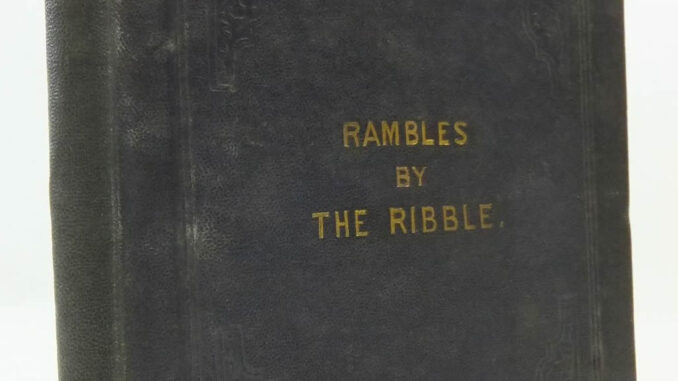
RAMBLES BY THE RIBBLE
CHAPTER VIII
WALTON-LE-DALE
Leaving the historically interesting district of Cuerdale, we enter upon the township and village of Walton-le-dale, a place which our old friend the Rev. John Clay, in an interesting series of lectures on the Ribble, which he delivered in the early days of the Preston Literary and Philosophical Institution, at its lecture hall, in the Exchange, described as “the prettiest village with the prettiest name in England.” As seen from Avenham walks, from the terraces in Avenham park, and from other parts of the Ribble valley, Walton-le-dale is a singularly pretty and pleasant part of Ribblesdale. Its high ground above the river, where the storied stream flows below its church-crowned hill and its wood bedecked slopes, forms a beautiful picture; indeed, as an attractive landscape, it is not excelled by any in the whole vale of the Ribble.
With the exception of Ribchester, Walton-le-dale is the oldest village on the banks of the Ribble ; its history goes back to the days when the Romans were masters of Britain. It had a population long before Preston was known to have even a cottage in its boundaries. It was the Coccium of Antonine’s survey of Britain.
In the account of the Roman roads in Lancashire, written by the Rev. E. Sibson, of Ashton- in-Makerfield, he stated that Walton-le-dale had been the site of a Roman station, but this statement did not generally excite the attention of historians and topographers.
Of the many investigations which sought to develop the geography of Roman Britain, the elder Whitaker, the historian of Manchester, the more erudite Whitaker, the historian of Whalley and Craven, and other conjectural writers on the subject-all left Walton out of their maps of Roman Lancashire. Mr. Sibson, in his investigations, was correct in the route he laid down for the iter, but he assumed that Coccium was at Fulwood, and that the Romans did not guard the pass of the Ribble where now is Walton-le-dale.
It was not until the year 1856, when Mr. Hardwick was gathering materials for his History of Preston and the neighbourhood, and he was on Walton Flats, near Messrs. Calvert’s mill, making such investigations as he could into the alterations that had taken place towards the close of the last century in the course of the river Darwen, near its debouchure into the river Ribble, that light dawned upon the matter. The late Mr. S. Cartwright, of Preston, had visited the spot about the same time, and he was a person of good antiquarian information and taste. When, one day, he and Mr. Hardwick were there together, they were shown some of the debris which had been turned up on some works then going on, and they saw among the soil that there were coins of undoubted Roman mintage, and some other equally ancient articles that had belonged to the same people. They also ascertained that on the building of Messrs. Calvert’s mill great stores of the same character had been disclosed, but unfortunately deficiency of taste, lack of information, and want of opportunity on the part of those who saw the disclosures which the spade and the pickaxe had made, prevented any information being obtained on the subject. On the occasion we have alluded to Mr. Hardwick saw that there was an opportunity afforded him of adding to the historical value of his book, of which he took advantage, and it is not too much to say that his chapter on Roman Lancashire is perhaps the most valuable feature in his History of Preston. He has also since that time contributed to the proceedings of the Lancashire and Cheshire Historic Society and other repertories of local historic lore valuable information on the Roman topography of the county, and also on the battlefields of Lancashire, as he was tempted to do on considering the question of the Cuerdale find, in regard to its being on the battle – field of Brunenburgh or some of the other feuds with the ancient masters of Britain.
The excavation that then took place on Walton Flats settled the point as to the locality of Coccium, in the tenth Iter of Antɔnine, and many antiquaries agree in accepting the Iter as so amended.
We shall not enter into details of the discovery ; those who are competent to form an opinion on the subject, and have considered it, are unanimous in the conclusion to which they have come. discovery, following the disclosure of the treasure at Cuerdale, about a mile and a half from the Walton find, tells that the inhabitants of the valley of the Ribble hereabouts played an important part in our history long before the battle of Hastings decided the mastership of Britain.
Without going unnecessarily into the details of the Roman topography of Lancashire, we may state that when the country was subject to its Trans – Alpine masters two roads came from the south to the north of England, on the west side of the inland, as also two on the east side ; the former coming through what is now Lancashire and the latter through the county of York. The former roads entered Lancashire, —one near Manchester (Mamucium), going on by way of Ribchester ( Rigodunum) to Overborough (Ad Alaunum), and so northward ; the other crossing the Mersey, near Warrington (Condate), coming by way of Wigan (Mancunium ), Walton-le-dale (Coccium), the Wyre Harbour ( Portus Setantiorum), Morecambe Bay (Moricambe Estuarium), Lancaster (Bremetonacis), & c. It was especially satisfactory to all persons who had ever given any thought to events of local antiquarian interest that what had long puzzled generations of persons who had given the closest attention to the subject had at length been clearly resolved. Indeed no portion of British history connected with the Roman epoch is now more clearly and more satisfactorily explained than the topography at that era of what is now Lancashire.
Although there was great uncertainty as to the route of Antonine’s Tenth Iter, in which Coccium was an acknowledged station, till this discovery was made, some antiquaries who had turned their attention to the subject considered that Walton-le-dale was a likely site for Coccium, but their suggestions did not meet with general concurrence. Early in this century, as we have said, the Rev. E. Sibson, of Ashton-in- Mackerfield, made a very careful survey of the Roman highway which enters Lancaster at Warrington, and proceeds on to Wigan, whence, he says, “the Roman road passes through Welsh Whittle, Euxton Burgh,
Rose Whittle, Bamber Green [ Bridge ], to Walton-le-dale, where it is probable there was a fortified camp to protect the pass of the Ribble; ” and from Walton he traced it to Fulwood Moor, Cadeley, Broughton, Barton, and Claughton, on to Lancaster. Dr. Robson, of Warrington, also said there was a Roman road along the western part of Lancashire, and fixed the site of Coccium at Fulwood, where the iter of Antonine crossed the route of Watling Street. Mr. Thompson Watkin, in his ” Roman Lancashire, ” prefers Wigan for Coccium, and says Walton is the not improbable site of Rigodunum.
Walton was, of course, visited by King James I. when on his way to Hoghton Tower, and his grandson, Charles II., passed through in 1650 when on his way from Scotland to the south of England.
In Preston his passage through does not appear to have been noticed particularly ; but, leaving Preston, he was lodged and entertained at Euxton Hall. and the Mercurius Publicus, of August 16th, 1650, thus records the call of the Stuart King on the Squire Anderton of that day :-
“Aug. 14, 1650. This day Charles Stuart lodged at Euxton burgh, six miles this side of Preston, being Sir Hugh Anderton’s house, who was prisoner at Lancaster, but sett at liberty by the Scotts. This Anderton is a bloody papist, and one that, when Prince Rupert was at Bolton, boasted much of being in blood to the elbows in that cruell massacre. The next night theyr King lodged at Brine, six miles from Warrington, being Sir William Gerard’s house, who is a subtile jesuitical papist. This dissembling Scot (Chas. II. ) trusts none so well in Lancashire for his hostes as the papists.”
The bridge over the Ribble at Walton was, until little more than a century ago, the last over the river in its westernly course towards the sea. On the north side of the bridge is an inscription that the bridge was built in 1779, 1780, and 1781, and that the cost of its erection was £4,200. It occupies a site somewhat to the east of its predecessor. The road known as Walton brow is a modern roadway, the ancient highway from Preston having been the continuation of Stoneygate by way of Syke Hill and Swillbrook Lane to Walton.
The present bridge consists of three arches ; its predecessor comprised five arches. Leland, in the reign of the Eighth Henry, described it as ” the great stone bridge of the Rybill, having V. great arches,” and as such it appears represented pictorially in Buck’s ” South Prospect of Preston, ” published early in the eighteenth century. The present bridge has itself no history ; its predecessors have witnessed some stirring incidents in the History of Lancashire. There is no reason to suppose there was a bridge in Roman or in Saxon days ; there would no doubt be a bridge in Norman or Norman English days ; but there is no record of a path over the river until the days of Henry III., in the thirteenth century,”where a bridge over Ribble ” is referred to, and from which we assume it had then been some time in existence. When Henry IV. was king, letters patent were granted for the pontage of the Ribble (“juxta Preston “) and for the ” pavinge of the said bridge.”
History tells us of more than one battle at Walton bridge. In the later days of Charles I., it was the scene of a bloody encounter between the Royalists, under the command of the Duke of Hamilton, and the soldiers whom Cromwell had led from Stonyhurst, and who had been victorious at Ribbleton Moor on their way, and who were again the victors in Walton, at the Ribble bridge and on “ Darwen’s stream.” In still earlier days Lancashire was scourged by an invading Scotch army, and the Ribble was the limit of the area invaded, so no doubt Preston then, like Ribchester, bore for a long time, heavy traces of the invaders’ visit.
Walton, or as it was called in Saxon days, Waltune, was then a royal possession, and it has passed through many hands-De Lacey, Banastre, Crouchback, and Langton. We have described the forfeiture of the manor by the latter family to the Hoghtons in our account of Hoghton Tower ; since which time (A.D. 1592 ) the Hoghtons have owned the estate of Walton Hall. Walton- le – dale has not been since void of historical incidents ; during the civil war between Charles I. and the Parliamentarians, as we have said, a great battle was fought (A.D. 1648 ) between the two in Walton, in which the Protector was the victor, and on which the muse of Milton has sung :-
“And Darwen’s stream with blood of Scots embued.”
At the Rebellion of 1715, when the hapless son of James II. sought to place on his own head the crown of his ancestors, his adherents came down on their southward march as far as Preston, where their hopes were frustrated, and where many supporters of the Stuarts lost their lives and their fortunes. A passage at arms took place here between the Royal forces and the Pretender’s supporters.
On this occasion ” General Woods, ” the Presbyterian minister of Chowbent, headed a detachment of volunteers, and guarded the passage of the Ribble against the Pretender’s army, whose forces he kept at bay till the advance of General Carpenter and General Willis, when the rebels were routed. Thirty years later ( A.D. 1745 ), the Young Pretender led on a number of Scotch and other adherents of the ancient dynasty of Stuart. This raid was not so soon stopped as the one of 1715 ; it passed Preston, went through Walton-le-dale to Manchester, and on to Derby, but found little favour in England, and seeing no prospect of success the leaders turned their faces homeward, and were followed by the Royal army, who, however, came not up with the rebels until near Inverness, and a terrible slaughter was effected at Culloden.
The annals of Walton-le-dale are not without some other little interesting historical incidents. In the days we have alluded to, when certain persons dreamed of being able to reinstate the Stuarts on the throne of their ancestors, a Jacobite club met at an inn in Walton under the designation of the “Corporation of the borough of Walton-le-dale.” They had regalia of a somewhat similar character to what are possessed by ordinary municipal corporations -mace, sword of state, halberds, and silver-mounted official staves ; one presented by the unfortunate Earl of Derwentwater, and another by Banastre Parker, Esq., predecessor of the present squire, of Cuerden.
Under the designation of mayor, recorder, bailiffs, slut kisser, custard eater, poet laureate, town clerk, and other titles, they met ostensibly for the discharge of municipal duties, but really to change a royal dynasty, for at one time the members included the Duke of Norfolk, Sir N. Sherburne, of Stonyhurst, C. Townley, Esq., of Towneley, and other disaffected members of the aristocracy of England ; and to the office of mayor of the Walton Corporation the distinguished persons named were appointed. As time progressed, the Jacobites as a public body became less powerful and influential, and the Corporation became more of a jovial gathering, members of the Whig aristocracy being admitted members, including Sir E. Stanley, Baronet, afterwards the eleventh Earl of Derby. With diminished dignity of the members and diminished danger to the gathering, the club continued to meet for some years, and then it was kept up merely as an ordinary ” beer and ‘ bacco club ” meeting, till, in 1796, it was closed altogether, when the regalia and records were taken charge of by Sir H. P. Hoghton, Baronet. When Walton Hall was pulled down in 1884, the former were taken charge of by R. Townley Parker, Esq., and they are now at Cuerden Hall ; the latter passed into the possession of Sir H. Bold- Hoghton, Baronet, and are now possessed by Sir Charles de Hoghton, Baronet, and are at Hoghton Tower.
We must now say a word on Walton Church. It is an ancient foundation and is within the ecclesiastical parish of Blackburn. Its history goes as far back as early in the thirteenth century, and in the incidents of the old ” God’s acre, ” there are records of the alchemist Kelley, pretending to consult the devil for some purpose or other through the medium of the dead in the church yard. Walton Church is a pretty picture in the landscape of the Ribble valley, and the graveyard itself commands beautiful views of the valleys of the Ribble and the Darwen, and as varied and interesting a landscape as almost any place in Ribblesdale can. Though the church is not noticeable architecturally, its chancel is interesting historically, as it contains memorials of the Hoghton and Assheton families. Of late years Walton has been the site of a considerable number of cotton mills, and has afforded employment to a large number of inhabitants in the staple trade of Lancashire. Bamber Bridge, within the township of Walton-le-dale, was early the seat of works in connection with the textile manufactures of the country, the Claytons of Bamber Bridge having established print works there in the year 1760. Cooper Hill, now the property of Sir Charles de Hoghton, Bart., but long owned by the Swainson family, was built something more than a century ago ; the design for it was furnished by General Burgoyne, M.P. for Preston 1768-92. Dr. Franklin, who twice visited Preston, and was on familiar terms with the general, fixed a lightning conductor to the house. The township of Walton-le-dale, besides its ancient parish church, has two other edifices devoted to the worship of the Established Church, at Bamber Bridge and at Higher Walton; two Roman Catholic chapels ; St. Mary’s at Brownedge, and St. Patrick’s in the Blackburn road, near the village ; two Wesleyan chapels, one at Bamber Bridge, and one at Higher Walton, also a school chapel at Walton village; and an Independent chapel at Bamber Bridge. During the mania for the construction of canals, one was planned from Kendal through Preston, to join the canal navigation of the south of England. It was cut to Preston, and from the Leeds and Liverpool Canal at Whittle to Walton, but the waterway between Walton and Preston was never completed, the valley of the Ribble at Avenham, Preston, forming too formidable an obstacle to its accomplishment; and instead of the canal being completed, a tramway was constructed to unite the navigations, and this has now given way to the locomotive railways which supply the town with coal and other goods requiring vehicular transport.
We have alluded to the historically interesting stream of Darwen passing through Walton. It joins the Ribble after a course over Walton Flats. In the beginning of this century the stream was straightened and shortened ; in times past it was one of the boundaries of ancient Coccium, so that Walton-le-dale or its site, at least, had achieved historic fame before it had been visited by Cromwell and noticed by Milton.
A few days ago (August 25th, 1883 ), a party of antiquarian savants, principally Manchester gentlemen, visited the site of Coccium, to examine the spot where the Romans once had their home, and which had been the means of disclosing a large number of reminiscences of the ancient lords of Britain. Of this party, our late townsman, Mr. Hardwick, was the leader, and he pointed out to his colleagues the principal features of the ancient Roman city, explaining the portions of what had been disclosed, and giving information of the coins and other noteworthy relics, which are stored in the town’s museum. After views had been exchanged on the historical incidents of the district,-for not only were the Roman incidents of Walton disclosed, but information was given respecting Cuerdale and its noted find of Anglo- Saxon coins, and Penwortham and its Castle Hill with associations of their Roman and other ancient inhabitants. After seeing Penwortham, Walton, and other features of interest, and talking of the associations of the district, the party partook of a well provided tea, at the Victoria Hotel, Preston, as a rule antiquaries do not neglect the inner man, so after the comfortable repast, a few speeches were indulged in, throwing information on the subject they were met upon. What was said about Penwortham and Preston is not within the limits of the present volume of the Rambles, but in the course of the after- tea discussion, Mr. Hardwick said he would submit to the meeting a few notes which he made after the digging in 1858 for Roman remains in Mr. Crozier’s garden at Walton. He regretted that some of the remains to which he had referred had been lost, but it was a pleasure to know that some of them were safely deposited in the Preston Museum, in the four boxes they had seen.
He had not the opportunity of saying to them when they were on the Flats that at a mile higher up than Walton was the place where the Cuerdale hoard was found. It was the largest hoard of Anglo- Saxon coins, ingots, and remains ever found, and he had connected that hoard with the Battle of Brunanburgh, his idea being that the site of the famous battle was to the south of the “Pass of the Ribble.” Amongst the names yet remaining indicative of this, were Brindle (Brunhull, in Saxton’s map), Brownedge ( Brunedge ), Bamber Bridge (Brunburh), and Brinscall (Brunscall). Cuerden (Wearden) was likewise confirmatory. The question is discussed at length in his recently published work “Some Ancient Battlefields in Lancashire.” If they had gone to Cuerdale he could have pointed out the place where the coins were found, but they would have seen no more than they saw at Walton. The quantity of remains taken from Walton must have been immense, and he was glad to see that there was so much pottery and so many of the coins were left. He hoped ere long to see them in the Harris Museum which was about to be erected in the Market-place. Respecting the search for remains at Walton, he might state that the first digging was undertaken twenty-eight years ago at a place called the Plump, from which most of the remains were obtained. The Roman coins he got from the garden were genuine, and he kept them in his possession until now, and they would go to the new Museum he was glad to say. He remarked that in the spring of 1858 a large quantity of Roman remains were dug up in the gardens occupied by Mr. Crozier, about 100 to 150 yards to the south of the “plump. ” Mr. Crozier’s garden was situated on the bank of the modern course of the Darwen, and was within the horseshoe figure formed by the old Darwen stream. The remains included two large fragments of lower and several of upper quern stones. A few coins were likewise picked up, three of which came into his (Mr. Hardwick’s) possession, viz., a second brass of Hadrian, with marks of fire upon it ; a second brass of Nerva, and a second brass of Faustina the younger. The Hadrian was one of those struck in commemoration of that emperor’s victories in Britain, and presents on the reverse the figure of Britannia seated on a rock. The reverse on the modern British copper coin is said to have been adopted from these Britannia types of Hadrian. A fourth, a second brass of Claudius, was sent to him about the time by a publican in Preston, who had taken it as a halfpenny in his ordinary business. Doubtless some of the coins at Walton had thus got into circulation. He heard of one or two first brass coins being picked up, but they got into the hands of mere curiosity collectors, who never thought of recording them. They found a curious fragment (about one -fourth) of a cut circular stone. The lower portion was flat and rough hewn ; the upper had been carved into the form of a shallow mortarium. Several large and smaller pieces of much corroded iron were discovered. One appeared to be a portion of a circular plate, the ornamented rim of which was of bronze. Several large and small iron nails were strewed on the Roman level, encrusted by those previously described, by sand and gravel.
A large space appeared covered by lamina of dark matter, apparently wood charcoal. The brass coin of Hadrian, previously referred to, had evidently been subjected to the action of fire. Two fragments of Roman glass were picked up. One appeared to be a portion of an ampulla handle, with projecting transverse ridges; the other is the portion of the neck of a vase, the inner portion of, which appeared to have received a thin coating of some pale yellow metal. He had noticed several specimens of glass with this curious inner coating in the museums at Lancaster, Shrewsbury, and other places. A large quantity of pottery was found of various descriptions, including Samian ware, the blue black Upchuch ware, the pale blue of the Durobriviam potteries, and several varieties in pale yellow, red and brown clays. One fragment of a patera has a curious full -like pattern around both its base and upper edge. It is formed of red clay, coated with a thin layer of pale opaque yellow. Several fragments of tiles were strewn about, both of the roofing and bonding character. One large fragment of Samian ware, with figures in relievo, was abstracted from the cabin before he (Mr. Hardwick) got to the ground, and he had not heard of it since. Many fragments of the bones of animals were strewn about. From their condition they evidently formed a portion of the debris of the food of the occupants of the station. Some of the workmen informed them that on digging for the foundation of some cottages which front the road in the neighbourhood of Messrs.Calvert’s mill, they came upon a very thick wall of remarkable masonry. The mortar was so hard that they only partially removed it. In some cases the foundations of the cottages rested upon this wall, which might have originally formed part of some Roman structure. Further opportunities for the examination of other portions of this wall might yet arise, as the neighbouring land might be built upon in a short time. The most interesting fact in connection with these remains was the locality in which they were discovered, being found in the garden occupied by Mr. Crozier, situated within the horseshoe bend of the Darwen, and outside what he (Mr. Hardwick) had concluded would be the southern boundary of the station. Robert Porter, in his map of the district, marked “a low place on Walton Cop overflowed by very high floods, ” opposite to the southern arm of this curve. This “low place ” might have in the Roman time connected the Ribble with the Darwen, and formed the ditch on the south side of the station. This would give the usual form of a Roman castrum, and would include within the natural and artificial trenches all the remains yet discovered. It was by no means improbable that the old erratic course of the Darwen might have resulted in the destruction of the station, from the earthquakes having overthrown and blocked up the more direct course. The part which included Mr. Crozier’s garden might possibly have formed a prætorium or inner camp. On the northern side of the station, however, a broad, high mound, originally separated by a ditch from the general camp, might perhaps with more probability claim this distinction.
In old times the Ribble was navigable much higher than it is at present, and in the last century it was no unusual circumstance for boats laden with coal and other cargo, to sail as far as the eastern borders of Walton-le-dale, and also up the Darwen, to discharge their cargoes. We have seen copies of petitions to parliament from Waltonians in the last century, complaining of the injury done to the navigation of the upper portions of the stream by the erection of cauls, and by other operations, in the channel of the river in and below Preston.
——————————————————–
Taken from the text in Rambles by the Ribble (Volume 3)
By William Dobson · 1864
This title is available via Google Books online:
https://www.google.co.uk/books/edition/Rambles_by_the_Ribble/GRYHAAAAQAAJ
.
Regarding the Cuerdale Hoard
It is now commonly believed that The Cuerdale Hoard was the largest hoard of Viking coins, ingots, jewellery to be found in the UK. Not Anglo-Saxon.