
Darwen Bank, standing in its own grounds of 70 acres, occupies an eminence near the village from which extensive and beautiful views of the neighbourhood may be obtained.
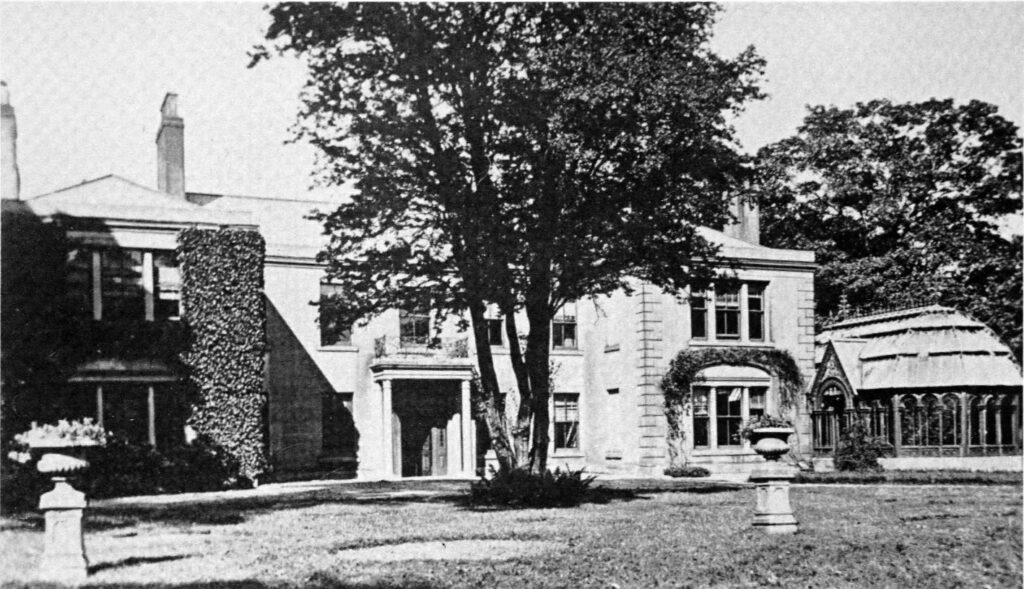
Darwen Bank was a substantial residence situated on the banks of the River Darwen at Walton-le-Dale. Approached by a private drive from Cottage Lane, the house stood within landscaped grounds that included pleasure gardens, plantations, orchards, meadow and pasture land amounting to around fourteen acres. By the late eighteenth century, it had become one of the principal private residences overlooking the industrial district around Mosney and the growing textile concerns of the area.

On the Ordnance Survey Map from 1848, Darwen Bank can be seen on the south edge of Mosney Wood, above the River Darwen. There is an Entrance Lodge on School Lane to the south of Darwen Bank and the shaded area on the map would have been the land directly associated with the house. The lodge is still in existence on School Lane, which is now known as Cottage Lane on that stretch.
~
Origins and Early Industrial Context
Darwen Bank appears to have emerged during the formative period of textile industrialisation in South Lancashire. The nearby Mosney works were associated with the firm of Livesey, Hargreaves, Hall & Co., noted in connection with the early development of cylinder printing in the 1780s.
A Mr. Hall — one of the Mosney partners — is recorded as living at Darwen Bank, suggesting that the house may have been built or first occupied by one of these early industrial entrepreneurs. This places the house within the generation of manufacturers contemporary with early factory expansion in Lancashire.
An informant mentions that the Liveseys had bleach-works at Bamber Bridge, and also a cotton mill at Higher Walton, which was purchased by Rodgett Brothers about 1859, and afterwards pulled down and a new mill built. Mr. Thomas Livesey resided at Knott House, and died there ; this house had previously been the residence of Mr. Anstie, one of the masters of the Mosney print-works ; Mr. Hall, another partner, resided at Darwen Bank, now the property of Mr. Rodgett. Knott House was since the mansion of Edmund Calvert, Esq. (Page 227)
From “A history of Blackburn town and parish” by William Alexander Abram (1835-1894), published in 1877.
Internet Archive:
https://archive.org/details/historyofblackbu00abrauoft/page/226/mode/2up?q=Anstie
The London Gazette of 7th February 1786 records Mr. John Hargreave, of Manchester, Calico-Printer, Copartner with John Livesey, Peter Ainstie, Joseph Smith, and William Hall, as Livesey, Hargreaves and Co.
While direct documentary proof of construction of Darwen Bank has not yet been located, the circumstantial evidence strongly suggests an origin in the later eighteenth century. Based on the William Hall connection, it would suggest that was in the 1780s.
The earliest references that are more substantial are to Ralph Assheton residing at Darwen Bank in the 1790s.
A John Boram of the Regional Furniture Society makes reference to domestic furniture made by Gillows in the late eighteenth century. There are entries in the company’s accounting records that shows sales to Ralph Assheton at Darwen Bank. These included:
COTTAGE CHAIRS (rush seats)
13 May 1793
Ralph Assheton, Darwen Bank,
12 cottage chairs, black ground @ 9/6 Total £5-14-0
SPINDLE BACKS AND SEDGWICK PATTERN CHAIRS (rush, matted & cane seats)
13 May 1793
Ralph Assheton, Darwen Bank,
6 spindle back armchairs japanned, light blue ground with dark
blue strokes and ribbons @ 17/0 Total £5-2-0There is a further order on 2nd September 1796.
Less conclusive is a Manchester Mercury Newspaper Subscription from 1794. It seems too much of a coincidence for it to be another person, but the name is documented incorrectly if it is Ralph Assheton.
THE following Subscriptions are in addition to those in the third Page of this Paper.
Ra. Ashton, Darwen Bank
Advertisement and Notices
Date: Tuesday, Oct. 14, 1794
Publication: Manchester Mercury
Gale Primary Sources, British Library Newspapers:
https://link.gale.com/apps/doc/CL3241473780/BNCN?u=lancs&sid=bookmark-BNCN&pg=1&xid=3f262fb2
~
Within the “Townships: Walton-le-Dale” section of ‘A History of the County of Lancaster’ (Volume 6) that was originally published by Victoria County History, London, in 1911, there is a reference to a Mr. Ralph Cockayne Assheton. This is with regard to the ‘The Estate’ at Walton le Dale.
The estate was purchased about 1800 by William Assheton of Downham and Cuerdale, whose great-grandson Mr. Ralph Cockayne Assheton of Downham is the present owner.
British History Online:
https://www.british-history.ac.uk/vch/lancs/vol6/pp289-300 [accessed 5th March 2026].
~
The Pedder Period (circa 1805–1811)
By 1805, Edward Pedder, jun., is recorded at Darwen Bank in the list of Lancashire Game Duty certificates.
In December 1807, the death of:
Mrs. Pedder, wife of Edward Pedder, Esq., of Darwen Bank
confirms the house as the established residence of the Pedder family at that date.
Pedder, a member of a prominent Preston banking family, was described as “Esq.,” indicating recognised gentlemanly status. In 1809, following the death of his first wife, he married Mary Robinson, formerly a dairymaid at the estate — a marriage noted locally for its social incongruity.
The Pedder tenure represents the phase in which Darwen Bank functioned clearly as a genteel country seat with a structured domestic household and managed grounds.
~
TO BE LET, FOR A TERM OF YEARS
THE capital MESSUAGE, called DARWEN BANK
TO BE LET,
FOR A TERM OF YEARS,
THE capital MESSUAGE, called DARWEN BANK,
with the appurtenances, in Walton-le-Dale, in the county of Lancaster; consisting of a large and commodious Dwelling-house and offices, part elegantly furnished, two Coach-houses, two Four-stall Stables, one Barn, and other outbuildings; a good Orchard, with a Green house and extensive Gardens and Pleasure-grounds; and also ten acres of Land, customary measure, belonging thereto.
The premises are pleasantly situated on the bank of the River Darwen, near the Vill of Walton, about two miles from Preston; and are well calculated for the residence of a genteel family.
Immediate possession will be given.
** Apply to Mr. MATTHEW BARTON, of Walton.
appurtenances – an accessory or other item associated with a particular activity or style of living.

Multiple Classified ads
Date: Saturday, Apr. 13, 1811
Publication: Lancaster Gazetter
Gale Primary Sources, British Library Newspapers:
https://link.gale.com/apps/doc/R3208487246/BNCN?u=lancs&sid=bookmark-BNCN&pg=2&xid=90832e9a
~
In 1832 the property was advertised “To be Let,” suggesting either another temporary leasing or preparation for eventual disposal. Following Pedder’s death, the house was offered for sale by auction in 1836.
DARWEN BANK. To be Let, by Private Treaty
DARWEN BANK.
To be Let, by Private Treaty,
ALL THAT
Beautiful RESIDENCE,
called DARWEN BANK,
SITUATE on the Banks of the River Darwen, and about 2 miles from Preston, together with the Coach-houses, Stables, Orchards, Gardens, Pleasure-grounds, and Plantations thereto belonging, and about fourteen acres of good Meadow and Pasture LAND, (or a greater or less quantity, at the option of the Taker.) The House contains an entrance Hall, large dining and drawing-rooms, two parlours, kitchens, eight good bed-rooms, a nursery, excellent cellaring, and other convenient offices, and is suitable for the occupation of a genteel family. Abraham Forshaw, at Darwen Bank, will shew the premises; and further particulars may be had on application to Mr. WILLIAM MILLER, Stanley Terrace, or at the office of CROSS and FORREST, solicitors, Preston.

Multiple Classified ads
Publication: Lancaster Gazetter
Date: Saturday, Aug. 18, 1832
Gale Primary Sources, British Library Newspapers:
https://link.gale.com/apps/doc/R3209088000/BNCN?u=lancs&sid=bookmark-BNCN&pg=1&xid=798366bb
~
SHOCK OF AN EARTHQUAKE. Yesterday morning, about five minutes before one, this town and the surrounding neighbourhood was visited by one of these, providentially, rare occurrences. The atmosphere was perfectly calm at the time, and though the sky was overcast with a hazy mist, there was not a breath of air to disturb the light strata of clouds. A low rumbling, subterraneous sound preceded the shock, or rather vibration, which lasted about three seconds. The motion was from south south-west to north, and was sufficiently violent to awaken a great number of sleepers. It was most severe on the south and east ends of the town, and in many houses articles were thrown from cornices and mantle-pieces by it. At Walton-le-Dale it was so severe, that the feathered inhabitants of the rookery at Darwen Bank, rose en masse, and wheeled round their nests in a body, uttering their hoarse cries. The surrounding districts appear to have been visited in a similar manner a few days since we have heard of it at Rochdale and the neighbourhood; the district to the north eastward of Manchester, Slaidburn, and other places have felt shocks. Yesterday’s shock felt at Longton. The shock was severely felt at Liverpool. It was experienced at Poulton and Kirkham, and wo are informed that at Fleetwood the shock was so great as to break several windows.

Date: Saturday, Mar. 18, 1843
Publication: Preston Chronicle
Gale Primary Sources, British Library Newspapers:
https://link.gale.com/apps/doc/Y3207421989/BNCN?u=lancs&sid=bookmark-BNCN&pg=2&xid=a9ab9751
~
Mid-Nineteenth Century: Rodgett Occupation
By the mid-nineteenth century, Darwen Bank was occupied by the Rodgett family, Preston mill owners who played a significant role in local industrial and civic development. The family are recorded as substantial contributors toward the building of All Saints’ Church and school.
At one point the household reportedly employed twelve servants and a gamekeeper, indicating that the estate remained a residence of considerable status and scale.
A rookery in the grounds — mentioned in the earthquake report — further confirms the presence of mature parkland trees and established landscaping.

‘Darwen Bank’, Cottage Lane, Walton-le-Dale, Preston
Former home of the Rodgett family, Preston Mill owners. Since demolished
~
In 1892 H.R.H. the Duke of Edinburgh Visited Darwen Bank
On Saturday, 25th June, 1892, the town was early astir. The morning was bright and hot and, although at times rather heavy clouds threatened rain, there was no break down in the weather until the opening ceremony was over. H.R.H. the Duke of Edinburgh had arrived on Friday evening and spent the night at Darwen Bank as the guest of Mr. John Humber, the Mayor. On Saturday forenoon be drove to the dock past crowds of people lining the route, which was decorated with flags and banners bearing wishes of “Success to Preston Docks,” and such like, and one florist, in the main street, had placed in his window the model of a vessel laden with flowers and sailing on a sea of violets.
~
Twentieth Century Occupants of Darwen Bank
The London Gazette on 14th January in 1927 makes reference to Hugh Hubberstey Barton, a Cotton and Cotton Waste Merchant, after his death.
Re HUGH HUBBERSTEY BARTON, Deceased.
Pursuant to the Trustee Act, 1925.
NOTICE is hereby given, that all persons having any claims against the estate of Hugh Hubberstey Barton, of ” Darwen Bank,” Walton-le-Dale, near Preston, in the county of Lancaster, Cotton and Cotton Waste Merchant (who died on 30th September, 1926, and whose will was proved at London, on 5th January, 1927, by the Public Trustee (Manchester), the executor therein named), are hereby required to send written particulars thereof to the Deputy Public Trustee, Albert-square, Manchester, before 15th March, 1927, after which date the said executor will proceed to distribute the assets of the said deceased amongst the persons entitled thereto, haying regard only to the claims and demands of which he shall then have had notice.—Dated this 12th day of January, 1927.
CHARLES J. FARRINGTON, 18, Ormond-avenue, Blackpool, Solicitor for the said Executor.
(152)

~
Within the Higher Walton section of the 1936 Barrett’s Directory of Preston & District there is a reference to Mrs. Ellen J. Barton residing at Darwen Bank house. It also mention a gardener.
HIGHER WALTON.
Barton Mrs. Ellen J. Darwen Bank house.
Tel. 85331 Bamber BridgeMasson Henry, gardnr, Darwen bank
From the 1936 Barrett’s Directory of Preston & District
~
Darwen Bank’s Decline
In subsequent decades the house experienced changing tenancy, and during the twentieth century it is noted as having served a variety of purposes before ultimately falling into decline and demolition. The site, once approached through formal grounds, became reduced to rubble.
Darwen Bank can be seen on this aerial photograph from May 1946.

Source Historic England Archive (RAF photography)
Date flown: 9th May 1946
Sortie: RAF/3G/TUD/UK/188
Photographer and Pilot: RAF
Ref: raf_3g_tud_uk_188_vp7_5528
.
Unfortunately, the aerial photograph has been taken in the oppsite direction to most standard maps, which normally have north at the top, so it appears to be, relatively speaking, upside down.
~
The location can be seen on this modern satellite image map of Mosney Woods, although Darwen Bank is not specifically marked. There is a small clearing in the woodland where the ruined remains of the building are.
~
~
Darwen Bank House Timeline
Circa 1780s – Earliest known Occupant • Mr. Hall — one of the Mosney partners
Circa 1790s – Furniture purchase records • Ralph Assheton
1805 Lancashire Game Duty certificate • Edward Pedder junior — member of the Preston banking family
Mid-nineteenth century • The Rodgett family — Preston mill owners
1892 H.R.H. Duke of Edinburgh Visit • Mr. John Humber — Mayor of Preston
1927 Pursuant to the Trustee Act (1925) • Hugh Hubberstey Barton — Cotton Waste Merchant
1936 Barrett’s Directory of Preston & District • Mrs. Ellen J. Barton