
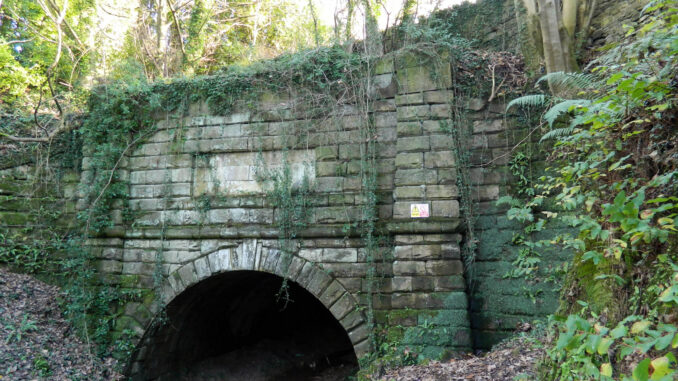
On the first instant, a Boat laden with Coal was navigated on the Lancaster Canal, thro’ the Tunnel at Whittle Hills, and her cargo was discharged into waggons at the termination of the Canal at Walton. Twenty seven waggons were laden, each containing about one ton, and were drawn by one horse, a mile and a half, along the rail road, to the works of Messrs Claytons, at Bamber Bridge. The waggons extended nearly one hundred yards in length upon the rail road; Geo. Clayton, of Lostock Hall, Esq. rode upon the first waggon, and the tops of the others were fully occupied. The intention of navigating a boat through the Tunnel, upon this day, was not generally known; it was merely a private experiment, but the news spread quickly to the adjoining parts; old and young left their habitations and employments to witness a sight so novel, and before the Boat reached her discharging place. She was completely crowded with passengers, who anxiously rushed into her at every bridge. The workmen were regaled with ale at Bamber Bridge; and amongst the toasts of the party were given, “The glorious first of June,” The memory of Lord Howe,” and “The healths of the surviving heroes of that memorable day.”
From the Manchester Mercury, 14th June 1803, p. 4. British Library Newspapers:
https://link.gale.com/apps/doc/CL3241475785/BNCN?u=lancs&sid=bookmark-BNCN&pg=4&xid=7c4487a1
From the Manchester Mercury
Manchester, June 14
Date: Tuesday, June 14, 1803
Publication: Manchester Mercury (Manchester, England)
Issue: 2700

Whilst this article talks about the effective completion and opening of the Southern section of the Lancaster Canal, navigating through the Tunnel at Whittle and onto Walton Summit. It then speaks of the onward journey to Bamber Bridge on a ‘rail road’.
Upon the rail road, specifically makes reference to the Tram Road. The then “New Tram Road”. Whilst coal would have already been finding its way to Preston via other forms of transport, horse and cart, this opening would have made a huge impact to the speed and efficiency with which the fuel could be brought to the town.
I have included an Ordnance Survey Map from approximately 50 years later. Whist things will have changed during that time, there is no reason to think that the works of Messrs Clayton(s), at Bamber Bridge wasn’t the area marked as the ‘Coal Yard’ on the map. When the workmen were regaled with ale at Bamber Bridge, conjecture on my part, but there is no reason to think that this wasn’t at The McKenzies Arms Inn.

Without going too much off-topic, you may notice an ‘Old Hall‘ marked on the old OS map. This is Little Walton Hall. The name Walton encompassed the whole area and Bamber Bridge was in it, so was Walton le Dale. Hence Walton Summit is the highest bit, which people would consider to be Clayton Brook (Clayton le Woods) now.
The later industrial estate, to the north of here, took its name from ‘Walton Summit’, it is not Walton Summit.
.
From the Preston Digital Archive
A PLAN of the Basin and Inclined Plane on the LANCASTER CANAL at the end of the Summit Level. William Cartwright 1801.

A number of black and white photographs of the disused canal, basin and tram road can be seen on the The Railway & Canal Historical Society’s Online Media Archive on their website. They accompany them with them with the following information:
Rather than being just a feeder to the canal, the plateway was actually an integral part of the canal line. On the south side of Preston, the land falls steeply to the River Ribble and its valley, so the engineering of a canal would have necessitated a series of locks to descend the slope, a substantial aqueduct to carry it across the Ribble, and a further series of locks to rise again to the summit levels at Walton Summit. Accordingly, it was decided to break the canal and interpose a tramroad over this section.
Apparently, there was controversy over the type of track to be laid, but eventually the Outram plateway was adopted. The line, which was opened on 1st June 1803, was laid to 5-feet gauge on blocks 2′ x 1′ x 10″ deep, and double track throughout. It continued in use until 1859, and the rails, incline, engine house etc. were taken up in 1868.
RCHS Online Media Archive:
With regard to the, “Outram plateway was adopted” comment, the reference is to design or idea that come from Benjamin Outram. He would have consulted, but he was not directly involved in the design or construction of the Lancaster Canal infrastructure.