
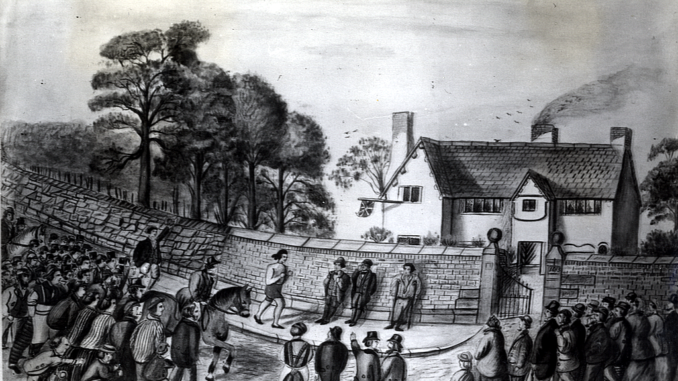
In one of my first forays into the Lancashire County Council’s Red Rose Collections, I came across an image of a pencil drawing that was dated to around 1870 and was of a scene at a place named as Little Walton Hall. It was a good find for me personally, I had previously noticed a place identified as “Old Hall’ on the mid nineteenth century Ordnance Survey map of Bamber Bridge. The map in itself had answered a long standing question. My grandparents had for a long time resided on Old Hall Drive. It seemed extremely likely that the residential street had been named after the Old Hall.

Discovering the pencil drawing was the first physical evidence of what the Old Hall might have looked like. Although, as is often the case with these things, it raises a few questions. The predominant one is, “what is happening at the Old Hall?” It seems like a fairly significant event is taking place. The information with the image on the Red Rose Collections website does not give any glues. Also, the artist is not known.
I have posted the image on a number of Facebook Groups before.
Little Walton Hall was a seventeenth century building, which stood on the site of Bamber Bridge Co-operative Stores in Station Road. This is the land between the modern day Co-Operative Street and Duke Street. Old Hall Drive is further west, and is likely named in reference to the ‘Old Hall’. It was occupied by Thomas Walton in the late 17th century.
Without going too much off topic, I have manipulated the image a few times from one that I downloaded to post. I try and avoid doing this on posts that are just a single image, as both the Red Rose Collections and the Flickr platform will create a viable image on the social media post if you link to the page in the collection that it is displayed on. That is the preferable method. However, this is impossible, if you want to do a post with more than one image.
The original image is wonderful, but it just comes across as being a bit dark (dull) on the original scan. I used a photo editing software on my computer to lighten it, by increasing the brightness and contrast a little bit. I later used AI. I asked the AI (Artificial Intelligence – ChatGPT) if it could colourise it. I had attempted to get the online software to do things like this in the past. To be honest, the results were okay, but the process took a long time and the creations always had something that ‘just wasn’t quite right’ about them. They are frowned on in a number of circles and, if you post such items, you will be met by the cry, “AI Slop!”

On this occasion, I personally feel it has played a blinder. The AI asked me a few question to clarify what I was looking for. After only a handful of seconds, it came back with the image that I have posted. I honestly think it is true to the original, but creates something a bit more vibrant than the original.
I also used AI to question what was happening in the scene, it is not obvious to me. I thought it might have been an old custom or ritual, and that potentially the ‘walker’ was being to subjected to some form of punishment and public humiliation. On one of the previous Facebook posts, a regular commenter suggested that it was a race. It seemed very plausible, but I still had my own theory in my head and I had never really heard reports of this type of ‘sporting’ event happening in the past at this locality.
In a totally random to this search, looking for things related to Moon’s Mill in historical local newspapers, the potential answer popped up. A section headed as “PEDESTRIANISM” appeared. What on earth is this? I have never heard of it.

PEDESTRIANISM
MATCHES TO COME.
Jan. 24-Handley, of Nottingham, and Middleton, of New Snenton, to run one mile, £30 a-side, within ten miles of Nottingham.
26-E. Smith, of Regent-street, and Nash, the Flying Cabman-£25 a-side, 130 yards, at Lord’s Ground.
27-Edward Wilde and Thomas Maxfield, alias the North Star, to run four miles, for £100 a-side, at Lord’s Cricket Ground.
29-Thomas Bowey and Robert Gowers, both of Kelton, 100 yds, for £10 a-side.
31-Boulton Phillips, of Newcastle, and John Grimshaw, of Gorton, 115 yards, for £25 a-side, at Knutsford
Feb. 1-The Doctor, of Newcastle-upon-Tyne, and Smith, the Regent-street Pet, 120 yards, £30 a-side, near London. [The 140 yards match, for £100 a-side, is off.]
7-W. Stow, of Blackburn, and S. Beatty, of Moons Mill, 150 yards, for £10 a-side, half way between those places
8-Ragsdale, of Carlton, and Franklin, of Nottingham, one mile, for £5 a-side
14-Cowlisham, of Nottingham, and Bland, of Derby, six score yards, for £20 a-side, at Shardlow.
21-John Atkinson and John Maguire, both of Durham, 100 yds, for £50, on Gilligate Moor.
It seems like it was a ‘betting’ thing. I was more being drawn into thinking about in the terms of modern athletics, when my regular commenter had suggested that the scene looked like (the conclusion of) a race.
~
Pedestrianism
My research of ‘Pedestrianism’ found that it was a wildly popular nineteenth century spectator sport in Britain, and America. It featured long-distance competitive walking and running, often spanning six days. It could perhaps be compared as a precursor to modern racewalking and ultrarunning. It evolved from wagering on footmen to professional, high-stakes endurance events in arenas like Madison Square Garden, making celebrities of walkers like Edward Payson Weston.
Looking at the events in the old newspaper article, many of them appear to be much shorter distances, unless I am misreading them and misunderstanding something.
In its earlier English form, pedestrianism was a much broader and less formalised activity. Matches were often arranged as individual challenges between two competitors, run or walked over agreed distances that could be very short or comparatively long. Many events were effectively sprints of 100–150 yards, staged at known landmarks, roads, grounds, or halls, and were closely tied to wagering, with each competitor staking their own money. These short-distance races coexisted alongside longer endurance contests and reflect an earlier, more localised and betting-driven phase of the sport, before the later development of highly organised, multi-day endurance events.
Pedestrian matches were organised in much the same way as prize fights of the period, with races arranged as head-to-head contests and formal terms publicly agreed in advance. Each competitor typically staked a fixed sum of money — described as “£ x a-side” — meaning that both runners backed themselves financially, with the winner taking the combined stake. These sums were far from trivial: stakes of £10 to £100 represented many months, and in some cases several years, of a working person’s wages in nineteenth-century Britain. In addition to the competitors’ own stakes, extensive side-betting by spectators was common, often greatly exceeding the official prize money, reinforcing both the sporting and gambling character of these events.
With regard to the specific event that drew my attention to this sporting activity, one of the competitors is said to be from Moons Mill, which is an earlier name for Higher Walton.
On the 7th February, W. Stow, of Blackburn, and S. Beatty, of Moons Mill, raced 150 yards, for £10 a-side, half way between those places.
Perhaps that means the event was at Hoghton.

Pedestrianism had two overlapping traditions
1. Early British pedestrianism (18th–early 19th centuries)
- Outdoor
- Often rural or semi-urban
- Short distances common
- Heavy betting culture
- One-off “matches”
- Very similar in structure to prize fighting
Distances ranged from:
- 60–150 yards (classic sprint challenges)
- quarter mile / half mile
- one mile
- occasionally multi-mile matches
Your 130-yard example fits this perfectly.
2. Later endurance pedestrianism (mid–late 19th centuries)
- Indoor arenas
- Multi-day events
- Lap counting
- Ticket sales
- Media hype
- Proto-ultrarunning
That phase did not replace sprint pedestrianism — it simply became more famous later.
130 yards is actually very pedestrianist
Short sprint matches were popular because they were:
- Easy to stage
- Easy to bet on
- Over quickly (repeatable excitement)
- Ideal for unevenly matched runners using:
- handicaps
- negotiated distances
You even see the same distances repeating:
- 100 yards
- 115 yards
- 120 yards
- 130 yards
- 150 yards
These are classic challenge-race lengths.
The ‘Pedestrianism – Matches to Come’ article is in the Gale Primary Sources, British Library Newspapers collection:
https://link.gale.com/apps/doc/BA3202399623/BNCN?u=lancs&sid=bookmark-BNCN&pg=9&xid=e084da8c
THE TRUE SPORTSMAN’S GAZETTE.
Publication: The Era
Date: Sunday, Jan. 23rd, 1842
Gale Primary Sources | British Library Newspapers