
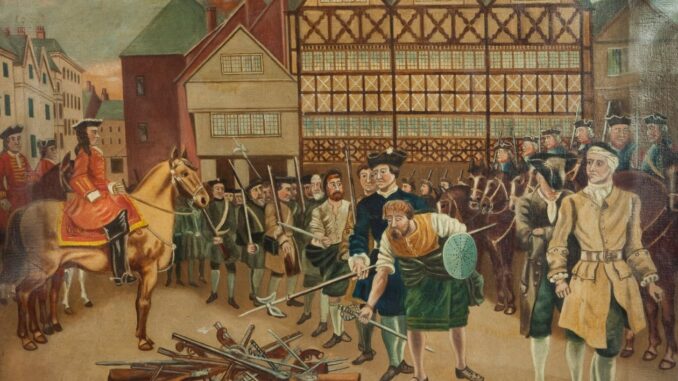
Tho. Coupe, weaver, executed at Preston for high treason, 28th January. 1715.
FOLLOWING the revolution of 1688, when James II fled to the continent, an act that led to his ultimate dispossession, much discontent, both political and religious, prevailed amongst the people, culminating in the Jacobite or Stuart revolts.
A number of Scottish nobility proclaimed Chevalier de St. George, son of James II. commonly known as the Old Pretender, as successor to the throne of England. There was a strong feeling, particularly amongst the Scottish Highlanders, in favour of the Stuart line to the throne, their purpose being to displace George I, who, on the death of Queen Anne, in 1714, became king of England. These Scots, headed by Earl Mar, were supported by several influential gentlemen from the northern counties of England, including Earls Derwentwater, Wintoun, Nithsdale, Carnwath, and a person named Thomas Forster, a plain country gentleman without any knowledge or experience in the art of war; he may have been selected by reason of his religious beliefs.
There seemed little doubt that those who formulated the insurrection hoped for the support of the Roman Catholics in the north of England, who still recognised the Pope as the supreme head of their church. Although the Presbyterians in Lancashire attached themselves to the Whig party-which name, by the way. bears its origin in Scotland, later to develop into the Liberal party -the Roman Catholics took an opposite view; this attitude occasioned no surprise, having in mind their profound recollections of the religious persecution they had been subjected to in the years past.
In the month of September, 1715. the Earl Mar left Braemar on his march south with about 12,000 men at his disposal. It was not until the 9th and 10th of November that the invading army arrived at Preston, having spent the previous night at Garstang. The rebels seem to have been imbued with a spirit of conviviality, if not with a complete lack of decorum, for we are told by the attorney’s clerk, who was a member of the expedition, that “the Ladys of this towne, Preston are so very beautifull and richly attired that the Gentleman Soldiers from Wednesday to Saturday minded nothing but courting and ffeasting.”
General Carpenter had been chosen by the government to suppress the rising, along with General Wills, the latter being stationed at this time in Chester. Apparently General Carpenter believed that Newcastle would be the place of interception, but on learning his mistake he crossed Yorkshire to oppose the rebels on their march from Carlisle. News in these days did not travel very rapidly, and whilst the insurgents evidently knew of Carpenter’s position they were unaware of the movement of General Wills.
Two dissenting ministers from Chowbent, well known for their loyalty to the House of Hanover, were invited by Sir Henry Hoghton, under the signature of General Wills, to give assistance to the king’s troops. The following is a copy of the letter:
“To the Rev. Mr. Woods, in Chowbent, for His Majesty’s Service,
Charles Wills.
“The officers here design to march at break of day for Preston, they have desired me to raise what men I can to meet us at Preston to-morrow, so desire you to raise all the force you can. I mean lusty younge fellows to draw up on Cuerden Green, to be there by 10 o’clock, to bring with them what arms they have fitt for service, and scythes put in streight polls, and such as have not, to bring spades and bill hooks for pioneering with. Pray go immediately all amongst your neighbours and give this notice.
I am your faithful servant.
H. Hoghton.”
Wigan,
11th November, 1715.
It would appear that these two ministers played no small part in the ensuing encounter.
On the morning of Saturday, November 12th, General Wills left Wigan, advancing north towards Preston, arriving Walton-le-Dale towards noon; he was surprised to find the Ribble Bridge unguarded. General McIntosh, of the rebel army, who had been detailed to hold the bridge, had, for some unaccountable reason, withdrawn his men. At this time the bridge at Walton-le-Dale was the only one crossing the Ribble in the vicinity.
Another record of Mr. Peter Clarke’s, the attorney’s clerk, throws some light on the reason of the retirement of General McIntosh and the Earl of Derwentwater. He says:
“Upon Saturday, the 12th November, 1715. about 11 o’clock in the forenoon, the Earl of Derwentwater ordered 300 horsemen to go to Ribble Bridge to oppose General Wills passage over it; but about an hour after General Wills and his men came into Walton-in-le-Dale, near unto the said Ribble Bridge, the said Earl Derwentwater’s men retired into Preston.”
It would seem that the Earl, on learning that his opponent was well established in the village of Walton-le-Dale, very discreetly returned to Preston, with the determination to defend the town. Barricades were erected in the principal streets and several fierce encounters took place before the Highlanders surrendered.
Two hostages were demanded by General Wills, and the Earl of Derwentwater and Brigadier McIntosh were delivered to Colonel Cotton on behalf of the General.
A few weeks after the capitulation of the rebel forces, a number of the prisoners were despatched to Wigan, Chester, and Lancaster for trial. Four of the six insurgent officers tried for desertion by a court martial at Preston were shot. Amongst the chief prisoners the Earl of Derwentwater and Viscount Kenmure, who were tried in London, found guilty of high treason, and beheaded on Tower Hill. Several leading officers escaped to find asylum on the continent, amongst whom were General Forster, the Earl of Nithsdale and the Earl of Wintoun.
In January, 1716, other prisoners were tried at Liverpool for complicity in the rebellion some were executed on the 28th January, and others on the 9th February, on what was then known as Gallows Hill, Preston. The Roman Catholic Church of English Martyrs is built on part of the site. Several local men paid the penalty, including William Butler, of Myerscough; Roger Muncaster, of Garstang; Richard Shuttleworth, of Preston; and Thomas Coupe, of Walton-le-Dale. In the burial ground of St. Leonard’s Church, Walton-le-Dale, is to be seen a flat memorial stone bearing the following: “William Coupe 1712. Thomas Coupe.” No date is given for the interment of the latter, but there is reason to believe that this was the Thomas Coupe executed on Gallows Hill. An entry in St. Leonard’s Parish Register states: “Tho. Coupe, weaver, executed at Preston for high treason, 28th January. 1715.”
After this somewhat inglorious expedition a number of the Scottish insurrectionists clandestinely remained loyal to the exiled Stuarts. The lowlanders, however, realised the benefits to be gained by a minion with England and reconciled themselves by submitting to the rule of an alien monarch in London.
In different parts of the country, especially where the Roman Catholic religion was predominant, societies or pseudo corporate bodies were established. These sympathisers to the Stuarts across the border cloaked their disloyalty to the Hanoverian dynasty in different ways, but their harmless activities were wisely ignored by the authorities. It was in support of this belief that the Mock Corporation of Walton-le-Dale owes its existence.
Amongst the several novels written by W. Harrison Ainsworth s “Preston Fight,” probably founded on Dr. Hibbert Ware’s Lancashire Memorials of 1715″; in this work is given a very Comprehensive story of the 1715 rebellion.
The above text is taken from Chapter 14 of ‘Walton le Dale | A History of the Village’ by Frank Coupe
(under the patronage of the Walton-le-Dale Urban District Council)
Publication date: 1954 | Publisher: Guardian Press