
The Roman Supply Depot
at Walton-le-Dale, Lancashire
This book, about “The Roman Supply Depot at Walton-le-Dale, Lancashire”, first became available late 2025. This was when Oxford Archaeology added a publication to their knowledge hub.
This book (published 15/07/2025) complete with two appendices can be downloaded in a compresses format, which has the three PDF documents within it. Oxford Archaeology link:
Download: https://knowledge.oxfordarchaeology.com/library/13038.


The Oxford Archaeology introductory text states the following:
“Winery Lane, at Walton-le-Dale, near Preston, Lancashire, is on the south bank of the river Ribble, at its confluence with the river Darwen, and is now flanked by modern development. In the nineteenth century, though, the fields there were found to contain Roman activity. Excavations to the north of the lane, funded by English Heritage (now Historic England) between 1981 and 1983, identified an industrial purpose for the site. Proposals to develop land to the south in the mid-1990s led to a second large-scale excavation in 1996 and 1997. The first Roman activity was in the late first or early second century, when large rectangular timber buildings were constructed, and in the south, an unusual round building, all containing industrial hearths. The sites were separated by the pre-canalised Darwen. Activity during the Hadrianic period grew, with post-in-trench buildings, consistent in size and layout, fronting an arterial road, heading for the lowest crossing-point over the Ribble. These were associated with hearths, pits, and water, and much of the space between was metalled. Buildings were modified or rebuilt over time, and in the mid-second century, they were replaced in the same style, undertaking the same range of industrial activities. These buildings were superseded around the end of the second century, in a different style using large individual earthfast posts. The later Roman site was poorly preserved, but the focus seems to have been a kiln, last fired c AD 285 producing oxidised coarsewares, similar to those from Wilderspool and Carlisle, perhaps by the same potters. There was little evidence of later activity. Many specialists have contributed to this volume, compiled over four decades, resulting in an in-depth analysis of a highly unusual site. It clearly supplied the Roman military in the far north-western extent of the empire, both with goods being brought by sea into the province and with the utilitarian needs of the army.”
What that doesn’t say is that there was knowledge of the site from at least the middle of the nineteenth century when Preston Historian, Charles Hardwick, was involved in the excavation and documentation of the Roman remains at Walton le Dale.

He wrote of the “Roman Remains Recently Discovered At Walton-le-dale”, in April 1856, for The Historic Society of Lancashire & Cheshire. It was included as a section in one of their annual publications. It can be viewed and downloaded here:
.
https://www.hslc.org.uk/wp-content/uploads/2017/10/8-10-Hardwick.pdf
.
Later, post the second world war – during the 1950s, a local archaeologist called Ernest Pickering, undertook systematic small-scale excavations, revealing evidence of a large and well-preserved Roman site.
Again, E. E. Pickering published work for The Historic Society of Lancashire & Cheshire in December 1956. His “Roman Walton-le-Dale, Excavation Report for the Years 1947-1957” can be viewed on and downloaded from their website: .
https://www.hslc.org.uk/wp-content/uploads/2017/06/109-2-Pickering.pdf
.
Both works are referenced in the Oxford Archaeology book.
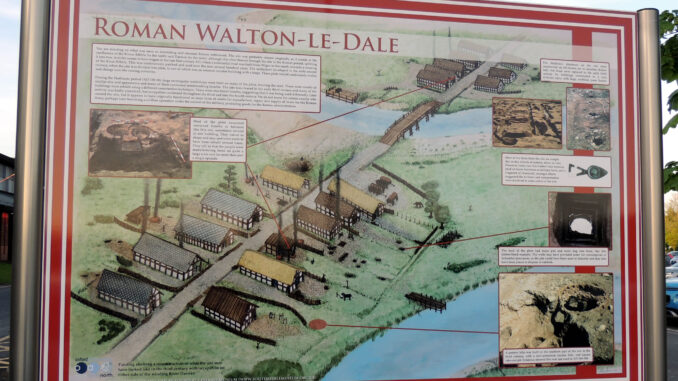
It is very much a ‘technical’ publication, but there is a lot of really interesting information contained within the pages. Again, a bit like the Cuerdale Hoard there isn’t really much to be physically seen locally. We’ll just have to make do with a sign on the car park, which is (oh, no, here he goes – moaning again…), in my opinion facing the wrong way. It points west, towards a little used part of the car park. It might have been better placed facing east and closer to the more frequented establishments.
The Roman settlement and industrial area at Winery Lane is listed on the National Heritage List for England. It has the Heritage Category of Scheduled Monument. This record was generated from an “old county number” (OCN) scheduling record. These are monuments that were not reviewed under the Monuments Protection Programme and are some of Historic England’s oldest designation records. As such, they do not yet have the full descriptions of their modernised counterparts available.
Historic England: https://historicengland.org.uk/listing/the-list/list-entry/1005086

The Roman Supply Depot at Walton-le-Dale Lancashire
Excavations 1981-3 and 1996-7
Winery Lane, at Walton-le-Dale, near Preston, Lancashire, is on the south bank of the river Ribble, at its confluence with the river Darwen, and is now flanked by modern development. In the nineteenth century, though, the fields there were found to contain Roman activity. Excavations to the north of the lane, funded by English Heritage (now Historic England) between 1981 and 1983, identified an industrial purpose for the site. Proposals to develop land to the south in the mid-1990s led to a second large-scale excavation in 1996 and 1997.
The first Roman activity was in the late first or early second century, when large rectangular timber buildings were constructed, and in the south, an unusual round building, all containing industrial hearths. The sites were separated by the pre-canalised Darwen. Activity during the Hadrianic period grew, with post-in-trench buildings, consistent in size and layout, fronting an arterial road, heading for the lowest crossing-point over the Ribble. These were associated with hearths, pits, and water, and much of the space between was metalled. Buildings were modified or rebuilt over time, and in the mid-second century, they were replaced in the same style, undertaking the same range of industrial activities.
These buildings were superseded around the end of the second century, in a different style using large individual earthfast posts. The later Roman site was poorly preserved, but the focus seems to have been a kiln, last fired c AD 285 producing oxidised coarsewares, similar to those from Wilderspool and Carlisle, perhaps by the same potters. There was little evidence of later activity.
Many specialists have contributed to this volume, compiled over four decades, resulting in an in-depth analysis of a highly unusual site. It clearly supplied the Roman military in the far north-western extent of the empire, both with goods being brought by sea into the province and with the utilitarian needs of the army.
This book (published 15/07/2025) complete with two appendices can be downloaded in a compresses format, which has the three PDF documents within it. Oxford Archaeology link:
Download: https://knowledge.oxfordarchaeology.com/library/13038.


