
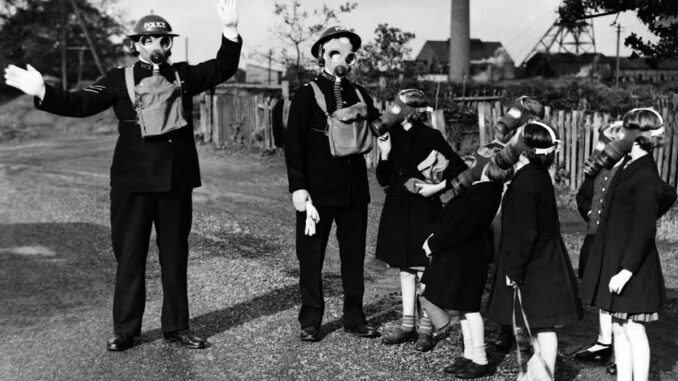
Date: Thursday, Aug. 6, 1936
Publication: Aberdeen Journal (Aberdeen, Scotland)
SAFETY DURING AIR RAIDS
Elaborate Precautions in Lancashire Parish
Elaborate precautions for the safety of human beings in the time of air attack are suggested for Walton-le-Dale, near Preston. The Urban Council there is the first of Lancashire’s local authorities to reveal its plans for the protection of the population against air raids. A sub-committee of the Walton-le-Dale Council has prepared a programme designed to meet the needs which might reasonably be expected to arise in the event of an air attack in which poison gas and incendiary bombs were used.
Decontamination Posts
Officials of the local council, it is planned, would be in charge of various branches of the work. The medical officer would be prepared to deal with the treatment of casualties and the decontamination of personnel by means of first-aid parties, first-aid decontamination posts, ambulance services, and a casualty hospital.
In a warning against gas poisoning, it is pointed out that the danger would not cease with the disappearance of enemy aircraft, as the type of gas which would be used in the next war would contaminate the clothing.
It would be necessary, therefore, for every-one after a raid to attend a decontamination post. Their clothing would be treated with chemicals to counteract the poison.
~
This 1936 article clearly reflects serious official expectation of another major war, even though it was still three years before the outbreak of the Second World War.
1. The political and military climate in 1936
By 1936, Europe was already re-arming and tension was high:
- Hitler had remilitarised the Rhineland in March 1936, in direct violation of the Treaty of Versailles.
- Italy under Mussolini had invaded Abyssinia (Ethiopia) the previous year.
- The Spanish Civil War broke out in July 1936.
- Air power was rapidly advancing, and the bombing of civilians in places such as Guernica (1937) soon shocked the world.
Britain’s government had begun to accept that air attack on civilians was likely in any future conflict, based on lessons from the First World War (Zeppelin and Gotha bomber raids on London) and the writings of strategists who predicted “the bomber will always get through.”
2. Civil defence measures already underway
The British government had, by 1935–36, established the Air Raid Precautions (ARP) Department under the Home Office. It sent guidance to local authorities—like Walton-le-Dale Urban District Council—on how to prepare for chemical and incendiary attacks.
These local committees were among the first wave of civilian defence planning efforts.
Your article shows how far ahead Lancashire councils were thinking: they were preparing not just for bombing, but for poison gas and clothing contamination—reflecting the prevailing fear that gas warfare (as seen in WWI) would return.
3. In summary
By August 1936, Britain was:
- Expecting another major European war sooner or later.
- Organising civil defence at local level in anticipation of air raids.
- Educating the public about gas attack precautions years before hostilities began.
Walton-le-Dale’s plan fits squarely into that national picture—it was an early adopter of what became the nationwide ARP system by 1938.
