
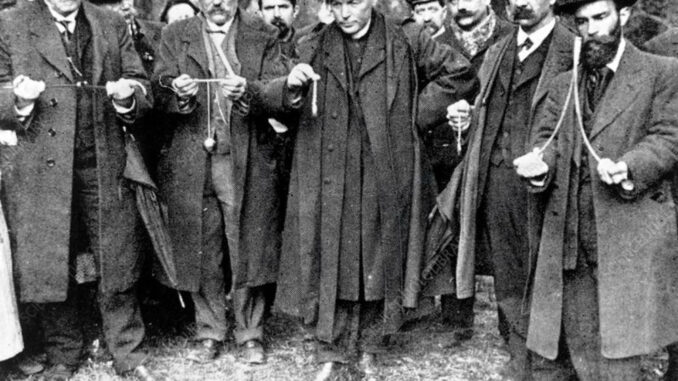
In the process of looking at a number of Water Tanks locally that have the ‘de Houghton’ crest on them, related to the Hoghton Tower Estate, I came across an interesting work studying the occupation of the Water Diviner (or dowser). It was a scientific study work that included information about a water finding exercise that had taken place at Hardshaw Hillock in Walton-le-Dale during the late Victorian era.

Mr. Leicester Gataker was a professional water-finder, regarded as reliable by the Hoghton Estate, whose work was later discussed sceptically — but not dismissively — by contemporary investigators. He appears to be a well-educated, respectable Victorian professional who made a living finding water, satisfied estate clients, worked in a disciplined and repeatable way — and was taken seriously by contemporaries, even as the cause of his success remained disputed.
At the time, Mr. Leicester Gataker, formerly of Weston-super-Mare, was residing at Crescent-gardens,
Bath. He was a gentleman by birth and education; his father was a captain in the Bengal Staff Corps, and the son, after leaving Bath College, where he was educated, discovered to his surprise that a forked twig revolved in his hands in the same way as it did with a local “diviner.”
It appears though, as the pictures show, that Leicester Gataker carried out his initial surveys with only his hands.
“I was much surprised to find that you first indicated the locality of the water with your hands and no rod, only using the rod as a secondary aid to confirm your indication.”

The following letter extracts were originally included in the ‘Proceedings of the Society for Psychical Research’ (Volume 13) publication of 1897-8. They are included in a section entitled, “On the So-called Divining Rod, or Virgula Divina”, which was by Professor W. F. Barrett.
On the So-called Divining Rod. Page 183
No. 125. —The next letters are addressed to Mr. Gataker from the agent to Sir J. de Hoghton, Bart., of Hoghton Tower, near Preston, Lancashire : —
Hoghton Estate Office, Walton-le-dale, Preston. April, 1895.
Several farms on these estates being short of water, your advice was obtained, and you pointed out places where water would be found, giving the depth.
In a field close to Hoghton Station, at one of these spots, where the depth was estimated at from 10 to 15 feet, a boring was made and water reached at 10 feet ; a well will probably be sunk there at some future time.
At Hardshaw Hillock, Walton-le-dale, you indicated a place where water might be found at from 20 to 25 feet. Here, in March, 1895, water was found in a bed of sand, after sinking through 22 feet of stiff marl, and a large supply is being yielded.
In this latter case, you used your hands only, without any rod.
Walter de H. Birch.
July 30th, 1895.
Another well has been sunk at a neighbouring farm, Leigh House, Walton-le-dale. Here you had indicated a spot where water would be found at from 30 to 35 feet deep.
After getting down 30 feet of exceptionally hard clay and marl, the well sinkers were beginning to lose heart, and the tenant suggested that a rain-water tank would answer his purpose, but continuing to sink, they struck a vein of sand at about 31 feet, with a good supply of water.
At 34 feet, clay was again reached, and boring 10 feet more at the bottom of the well showed only hard clay, so it was decided to “let well alone,” as the result was so satisfactory.
Walter de H. Birch.
Professor Barrett wrote to Mr. Birch to inquire if any previous attempts to find water had been made, and what was the result, and whether Mr. Gataker had any failures.
The following is the reply that he received : —
Hoghton Estate Office, Walton-le-Dale, Preston, April 12th, 1897.
Mr. Gataker certainly has been remarkably accurate in his estimate of the depth at which water will be found, though sometimes he has been wronsj. I do not place much reliance upon his estimate of quantity.
His most notable failure was the last. Here he gave the depth at from 12 to 18 feet, but after sinking that in quite dry sand, he came again and said there must be a quicksand, which threw him out, and that it was about 60 to 70 feet deep. We bored through dry sand, and found a quicksand at a depth of 72 feet, so that he redeemed his character in this. This is a list of his predictions, and the results : —
| Letter | Estimated | Actual | Remarks |
|---|---|---|---|
| a. | 20 ft. | 22 ft. | Good supply. |
| b. | 20 ft. | 8 and 37 ft. | Two springs, one above the other. |
| c. | 25 ft. | 10 ft. | Very small spring. |
| d. | 30 ft. to 35 ft. | 34 ft. | |
| e. | 10 ft. to 15 ft. | 10 ft. | |
| f. | 15 ft. | about 15 ft. | |
| g. | 20 ft. to 30 ft. | about 11 ft. | A fair stream. More water lower down; two springs at different depths. |
| h. | 30 ft. | Here water was found on boring and rose in the bore to 22 feet from the surface. Exact depth of spring not ascertained. | |
| i. | 12 ft. to 18 ft. | No water, but on boring deeper, a quicksand struck at 72 ft, as already mentioned. |
Note: In “g” there was more water lower down, and you will notice that in the least accurate estimates there were two springs at different depths.
Walter de H. Birch.
Proceedings of the Society for Psychical Research (Volume 13) published 1898
On the So-called Divining Rod, or Virgula Divina by Professor W. F. Barrett:
https://iapsop.com/archive/materials/spr_proceedings/spr_proceedings_v13_1897-8.pdf
Sir William Fletcher Barrett (10th February 1844 – 26th May 1925) was an English physicist and parapsychologist.
In broad terms, the Society for Psychical Research (SPR) was an attempt to do something very Victorian and very awkward, which was to investigate extraordinary human experiences seriously, without immediately calling them either miracles or frauds.
Their stated aim was to:
“examine without prejudice or prepossession and in a scientific spirit those faculties of man, real or supposed, which appear to be inexplicable on any generally recognised hypothesis.”
Ordnance Survey Map
Hardshaw Hillock Farm in Walton-le-Dale on 1910 Ordnance Survey Map,
via the National Library of Scotland: