
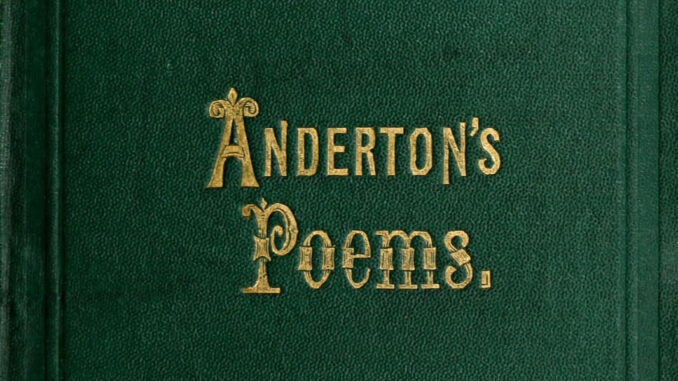
The ‘Life and poems of Henry Anderton, of Walton-le-Dale.’
Henry Anderton was born at Walton-le-Dale on 3rd, December 1808, and was one of the early Preston abstainers. He was a popular speaker, and his poems were widely recited and sung. A complete edition of his Poems, with a Memoir by E. Grubb, was published in 1863, as;
The temperance, and other poems of the late Henry Anderton, of Walton-le-Dale, near Preston, with a sketch of his life by Anderton, Henry
Henry Anderton was a saddler by trade in the Preston area and became closely associated with the early temperance movement, where he gained a local reputation as a popular speaker and poet. Often referred to as the “Temperance Poet,” his verses were widely recited and sung within abstinence circles. He died comparatively young, at around forty-six years of age, and was buried in his the place of his birth, Walton-le-Dale. After his death, his poems were published in collected form, accompanied by biographical sketches that helped preserve his memory and influence.
Another book was published in 1868. This was entitled;
Life and poems of Henry Anderton, of Walton-le-Dale by Anderton, Henry, 1808-1855
PREFACE.
It is matter both of interest and instruction, when studying the history of the great movements which have shaped the course of the world’s thought and action, to know something of the great actors, the leading minds, the master spirits, who led those movements. For truly the men are the best illustrations of their work. Interesting indeed it is to know the life and temper of Luther, and to observe its influence upon his time and work; and of our own Latimer, and the martyr-witness which he left us; to read the memoir of Stephenson-that man of the north, whose genius and labours have wrought such a mighty change in the commercial position of his country; to know something of that noble Englishman, the large-hearted Wilberforce, the champion of freedom on British soil; and deeper and stronger still than any of these, is the interest which every Christian man feels in the life and deeds of Him, the Holy One, who came “to bind up the broken-hearted, to proclaim liberty to the captives, and the opening of the prison to them that are bound.”
And so, in the history of Total Abstinence, stands out in striking clearness the eager form of HENRY ANDERTON; a man whose poetry, earnestness, and eloquence, not less than the great kindness of his heart, have endeared his memory to all earnest and loving men.
Born, too, in the lovely Lancashire village of Walton-le-Dale; nursed by the banks of its beautiful river,-where stood once the hut of the ancient Briton; where the Roman formed his camp; a spot which has been the theatre of important events in our national history; whence has gone forth many a good man and true, who has done work in the world, and many another who is doing it still, his life cannot fail to be of deep interest to some of us. There he spent his early days; there he fought some of the noblest struggles of his life; and there, now he is gone, rests all that remains of him, in the quiet churchyard grave.
But the dearest of all causes to our hearts should be the cause of truth-truth, the very germ of all life-TRUTH, the very attribute of the Eternal. And when, amidst mistakes, ignorance, and misrepresentations, such different impressions of Anderton prevail, it is due to those who knew him to those who bear his name those of his own family and kindred that some true and authentic memoir of him should be published, by those whose position and knowledge of him enable them to fulfil the task.
For these reasons, his relatives have given this volume to the world. It comes as a light upon the early history of Total Abstinence; it comes as an offering cast upon the altar of Truth; it comes as a loving tribute to the memory of a good man.
WALTON-LE-DALE.
Q.
NOTE.
IT was originally intended to publish a volume which, while it refuted the many errors contained in Mr. Grubb’s edition, would give an authentic account of the life and times of Henry Anderton. The gentleman who was engaged in this work, and who had almost completed it, has rested from his labours; and, as many friends had been earnestly looking forward to the promised volume, these short memoirs have been somewhat hastily put together, and are now sent out to the public, together with the poems, in the hope that they may be instrumental in advancing the great and good cause of Total Abstinence.
THE Committee of the BURY ABSTINENCE SOCIETY respectfully record their sense of the value of the services of the late Mr. HENRY ANDERTON to the cause of Temperance-both by the living voice and the pen of poetic fire in the early struggles of the great moral movement of the age. They desire to express their sincere sympathy with the bereaved family; and, in veneration of the departed, they shall ever cherish a sacred regard for the widow and the fatherless.
THE TEMPERANCE AND OTHER POEMS OF THE LATE HENRY ANDERTΟΝ,
WITH A SKETCH OF HIS LIFE, BY HIS FRIEND AND FELLOW-LABOURER, EDWARD GRUBB.
The temperance, and other poems of the late Henry Anderton, of Walton-le-Dale, near Preston, with a sketch of his life by Anderton, Henry
Publication date: 1863
Internet Archive:
https://archive.org/details/temperanceotherp00anderich/mode/2up
~
LIFE AND POEMS OF HENRY ANDERTON, OF WALTON-LE-DALE
Life and poems of Henry Anderton, of Walton-le-Dale
by Anderton, Henry, 1808-1855
Publication date: 1868
Internet Archive:
https://archive.org/details/lifepoemsofhenry00ande/page/n1/mode/2up
The 1868 volume appears to have been published less as a simple literary collection than as a corrective and commemorative work. It arose from dissatisfaction with earlier biographical accounts of Henry Anderton, which were felt by his family and close associates to contain omissions, errors, and an incomplete understanding of his life and character. An intended full and authoritative biography was begun but left unfinished due to the death of the person undertaking it. In its place, Anderton’s relatives brought together a series of shorter memoirs, personal recollections, and institutional testimonials, accompanied by his poems, in order to place on record what they regarded as a more truthful and affectionate account of his life. The book seeks both to anchor Anderton firmly in his family and birthplace at Walton-le-Dale and to affirm his wider importance within the early temperance movement, particularly through the inclusion of tributes from figures and societies who had known his work. In doing so, it functions as an act of reputation-keeping as much as a memorial, preserving his moral legacy at a moment when his memory was in danger of being simplified, misunderstood, or quietly distorted.

ILLNESS AND DEATH.
In June, 1855, he caught a cold, which brought on a fatal illness. At the end of a short illness of eight days he passed away in peace, at the age of forty-six years. His remains were interred in the churchyard of his native village, Walton-le-Dale, Preston.