
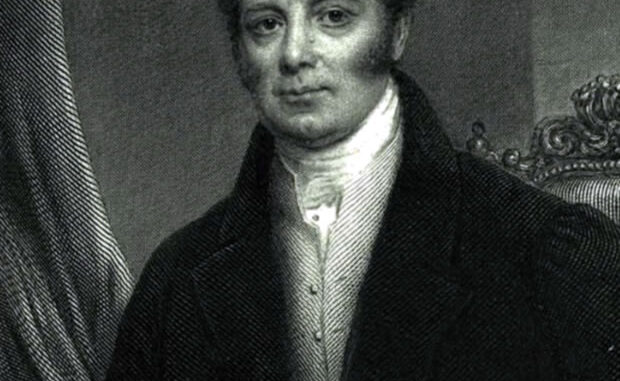
Edward Baines was born in 1774 at Walton-le-Dale. He was educated at Hawkshead Grammar School (where Wordsworth was a contemporary), and then in the lower school of the grammar school in Preston. He then became a weaver, but at the age of sixteen he was apprenticed for seven years to a printer in Preston. In the fifth year of his apprenticeship, he terminated it and moved to Leeds, where he finished his apprenticeship with the printer of the Leeds Mercury, one of two Leeds weekly newspapers.
Edward Baines was later the editor and proprietor of the Leeds Mercury, politician, and the author of historical and geographic works of reference. On his death in 1848, the Leeds Intelligencer (a rival of the Mercury, and its political opponent for over forty years) described his as “one who has earned for himself an indisputable title to be numbered among the notable men of Leeds”.
The Leeds Mercury, by his efforts, became the leading provincial paper of its era in England.
Dame Jilly Cooper, DBE (born Jill Sallitt; 21 February 1937) the author is said to be a descendent of the family.
~
The Historian of Lancashire
In the year 1772, the corporation renewed their prosecutions against “merchant strangers,” who had established themselves in the town of Preston, without possessing the qualification as freemen of the borough j and in the corporation books of the date of the 6th of April in that year, the following entry appears : —
” Received into stock from the subscribers to Baines’s prosecution towards paying Mr. Grimshaw’s Bill from Thomas Walshman £47. 7s. 8d.”
And on the credit, or opposite side of the Ledger —
*’ Rec** 27th April, 1 772, from the Mercers, Grocers, &c. Company, within the borough of Preston, the sum of £45, by the hands of Mr. Walshman and Mr. Derbyshire, the wardens, in full for my costs of the Prosecutions against Baines to March Assizes last. ” John Grimshaw.”
With the history of this prosecution, one of the last remaining vestiges of feudal policy, we have reason to be familiarly acquainted. The effect was to subject Mr. Baines to expenses amounting to several hundreds of pounds, and ultimately to oblige him to remove from Preston to Walton-le-Dale. A short time previously, Mr. Baines had married Jane, the daughter of Edward Chew, esq. a gentleman long engaged in the East India trade, maternally descended from the Rigbys of Middleton Hall ; and the author of this work, being the second son of that marriage, was born at Walton on the 5th of February, in the year 1774. Till he had attained almost to manhood, he resided in Preston; he then removed to Leeds in Yorkshire, where he has been long established, but with undiminished attachment to his native county ; inspired by this feeling, he seeks to add to any other honours that he may have attained, the proud distinction of ” The Historian of Lancashire.”
~
From the History of the county palatine and duchy of Lancaster. The biographical department by W.R. Whatton
by Baines, Edward, 1774-1848
- Baines’ Role: Baines wrote the main body of the history — covering towns, parishes, manorial history, the county’s governance, and its overall development.
- Whatton’s Role: W.R. Whatton was brought in to write the biographical entries — short lives of significant figures from Lancashire’s history. His contributions were likely included as either an appendix or a dedicated section in one or more volumes or editions.
Read online and download from:
https://archive.org/details/historyofcounty01bain/page/360/mode/2up
Edward Baines was born on Saturday 5th February 1774, when Jane Baines presented her husband Richard, a cotton trader, with their second son. Their first child, Thomas, had been born two years previously and Jane would go on to bear four more children in the following twelve years; Elizabeth in 1776, Jane in 1779, John in 1783 and Mary Ann in 1786.2 Edward’s birth took place at Walton-le-Dale. Thus he was born a Lancastrian ‘with undiminished attachment to his native county’, and proud enough of the fact that he bequeathed the manuscript of his history of Lancashire to the Dr Shepherd Library in Preston.
Baines originally followed his father into the cotton trade, learning the craft of weaving. However, in 1790, he realised that to fulfil himself he needed a more stimulating and intellectual challenge and his father accordingly apprenticed him to Thomas Walker, a Preston stationer and printer. Walker had commenced business in the town about the same year that Baines became his apprentice. A year previously the French Revolution had exploded on the world. The reverberations of the social and political upheaval in France echoed across the Channel and resulted in an upsurge of radical sentiment throughout the country. Walker realised the demand for news was paramount and decided to launch the Preston Review.
At the beginning of 1795 Baines asked Walker for his indentures, despite still having two years to go before completion of his seven year apprenticeship. Why did Baines decide to break his contract, depart Preston and complete his term elsewhere? The reasons normally given are confusing.
It appears that a famous visitor to Walton le Dale had been a significant influence on Edward Baines. Benjamin Franlkin, the American patriot, had long been Baines’s idol to the extent that, in 1822, Baines even attended the Preston Guild dressed as him.
On 10th July 1848, Edward Baines suffered a serious haemorrhage. Nine days later his condition seriously deteriorated. His appearance became shrunken and wan; he lost his appetite; his strength was gone. His seventy-four year old body was simply exhausted. t a quarter to midnight on Thursday 3rd August 1848, Edward Baines died.
Following Edward Baines death, there were many who recognised his life, these included his journalist colleagues and competitors. His had been ‘a career distinguished by so much merit’- Morning Advertiser. He was ‘the Franklin of his country’ – Christian Witness. ‘A man before his age’ – Evangelical Magazine. He
raised himself and his family ‘without any sacrifice of independence’ – Manchester Examiner and Times. He possessed ‘persevering industry and undeviating integrity – Bradford Observer. He displayed an ‘unswerving attachment to the principles of civil and religious liberty.’ – Hull Advertiser. His paper became ‘one of the most powerful organs of public opinion in the provinces.’ – Preston Chronicle. The Leeds
Intelligeneer‘s observation was a simple one; his had been a ‘well spent life.’
This more detailed information comes from ‘Mr Mercury – A Biographical Study of Edward Baines with Special Reference to His Role as Editor, Author and Politician’, which was submitted in accordance with the requirements for the Degree Of Doctor of Philosophy at The University Of Leeds School Of History in July 1999 by David Thornton.
https://etheses.whiterose.ac.uk/id/eprint/441