
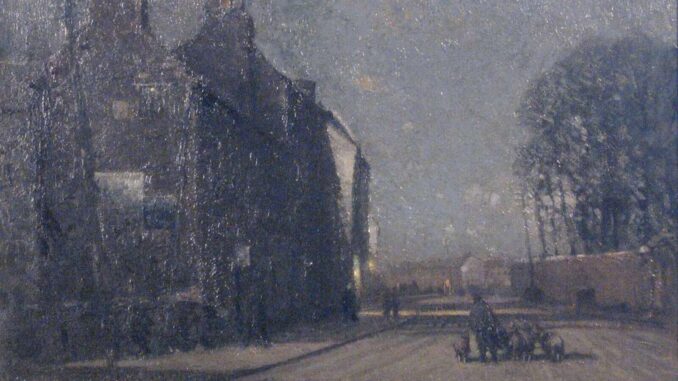
“…he was overtaken by four men, a short distance from the turnpike on Walton Brow.”
Desperate Gang of Highwaymen,
in the vicinity of Preston.
On the night of Friday the 9th, about half past eight o’clock, as Mr. Birchall, of the Clerk of the Peace’s Office, in Preston, in and Mr. Chaffers, bridgemaster, were returning from Tarleton, in a gig, they were attacked by five highwaymen, opposite the mile-stone near Penwortham Bridge. One of the men called upon them, with imprecations, to stop; and three of the gang, armed with pistols, immediately left the foot-path and approached towards the gig. Mr. Chaffers, who held the reins, was preparing to strike a blow with his whip, but Mr. Birchall urged him to push on, which he accordingly did, and they thus escaped. One of the villains, however, fired a pistol after them, which fortunately missed its aim, N. Grimshaw, Esq. being informed of the circumstance, dispatched a constable and assistants in search of the daring outlaws, but they were not able to meet with them.
On the same evening, about a quarter-past nine, as Mr. Thomas Sutcliffe was proceeding home to Bamber Bridge, he was overtaken by four men, a short distance from the turnpike on Walton Brow. On coming up with him, one of the men took him familiarly by the arm, and they walked together for some distance, in this way, when Sutcliffe began to question them as to their object, supposing them to be poachers: he had scarcely spoken on this subject, when one of them seized him by the throat, threw him on his back, and the gang immediately proceeded to rifle his pockets. They got from him his handkerchief, some tea, and his pocket-book, containing £14 in notes. He asked them to return his pocket-book, as it contained some memorandums which would be of no use to them. With this request they complied, and immediately struck off into the fields, by a path which leads to Holland House. Being a little in liquor, Sutcliffe followed them a short distance, but they soon shewed him the danger of such a course, by firing a pistol in the air and threatening to shoot him, if he did not return into the road.
There can be little doubt but the robbers, in both cases, were the same individuals. Several persons have, in the course of the week, been apprehended on suspicion, but the real villains have not yet been identified.
Publication: Lancaster Gazetter Saturday, Feb. 24, 1821
Gale Primary Sources – British Library Newspapers
https://link.gale.com/apps/doc/R3209080111/BNCN?u=lancs&sid=bookmark-BNCN&pg=3&xid=9901ef9b


N. Grimshaw, Esq.
Nicolas Grimshaw was a lawyer in Preston who established his own legal practice at 10 Winckley Street in 1823, having previously worked in his father Thomas Grimshaw’s law firm. He was among the earliest residents of what later became Winckley Square, purchasing land and building a house in 1801 at Winckley Place (subsequently known as Winckley Square). Grimshaw was commissioned as Captain Commandant, Major, and later Lieutenant Colonel of the Royal Preston Volunteers, and subsequently served with the Militia. He served as Mayor of Preston on several occasions, including during the Guild years of 1802 and 1822.
One of the most noted and successful of the Grimshaws in their native Lancashire was Nicholas, a member of the Pendle Forest line who served as mayor of Preston seven times….
Friends of Winckley Square: https://www.winckleysquarepreston.org/heritage/nicholas-grimshaw
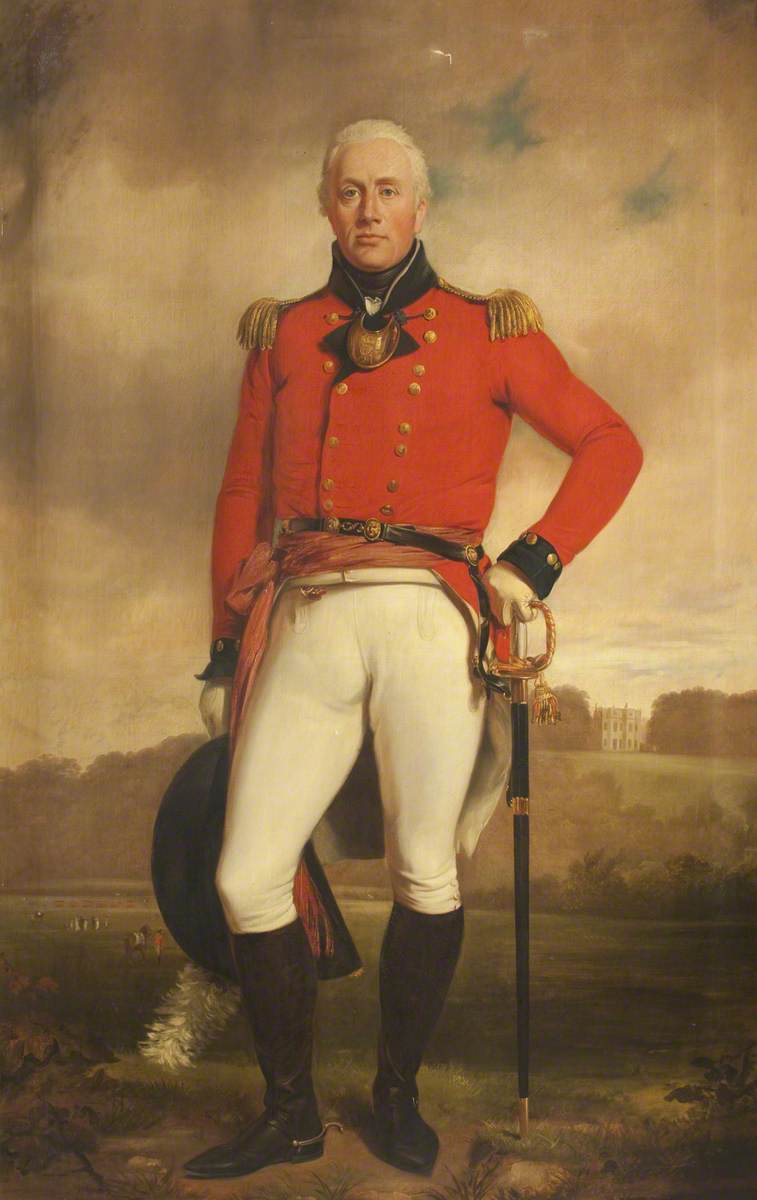
Richard Chaffer, Bridge Master
Mr. Chaffers, bridgemaster, would refer to a Mr. R. Chaffer, bridge master for the Blackburn hundred. Other evidence seems to confirm that he was Mr. Richard Chaffer, Bridge Master.
Marriage: 6 Oct 1841 St Peter, Burnley, Lancashire
Richard Howard – Full, Druggist, Bachelor, St. James St., Burnley
Ann Chaffer – Full, Spinster, Church St, Burnley
Groom’s Father: John Howard, Agent
Bride’s Father: Richard Chaffer, Bridge Master
Witnesses: Obadiah Folds?; Thomas Chaffer
Married by Licence by Robt. Mosley Master
Register: Marriages 1841 – 1845, Page 32, Entry 64
Source: Original Parish Register
From the Lancashire OnLine Parish Clerks:
https://www.lan-opc.org.uk/Burnley/Burnley/stpeter/marriages_1841-1845.html