
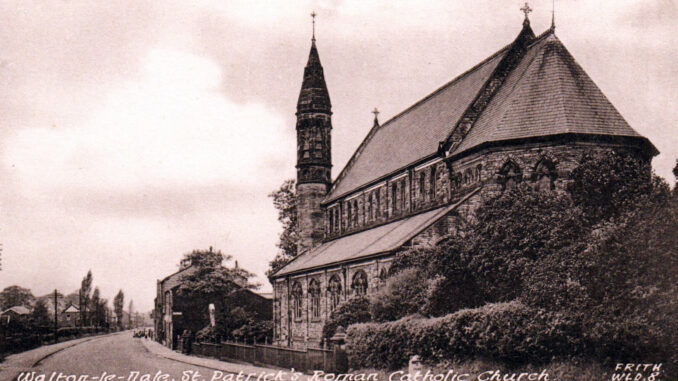
THIS church is now in course of erection, and consists of nave, gallery, approached by stairs in the bell turret. The church is built with hollow walls, the inside being of brick and the outside of Yorkshire pierpoints, the whole of the dressings being in Stourton stone. The length of church is 96 feet, and the width across nave and aisles 53 feet. The height to apex of nave roof is 50 feet, and the height of bell turret 70 feet. The whole of the woodwork is of pitch pine, excepting the outer doors, which are of oak. The presbytery will be connected with the church by a corridor leading to sacristy. The church will accommodate about 500 people, and the cost, when finished, will be a little over 5,000l. The architects are Messrs. PUGIN & PUGIN, of Westminster, and the contractor Mr. W. HOTHERSALL, of Preston.

The Architect. February 14th 1880
From The Architect and building news (January-June 1880)
~
~
The Roman Catholic Church of Our Lady and St Patrick,
Walton-le-Dale
Originally formed in 1855 by the Benedictine order, the Parish of Our Lady and St Patrick (originally the Mission of St Patrick) includes both The Pugin Church of Our Lady and St Patrick and St Patrick’s Roman Catholic Primary School and has served Walton-le-Dale and surrounding area for over 150 years.
The Roman Catholic Church of Our Lady and St Patrick in Walton le Dale, Lancashire, with attached presbytery and gate piers, is listed on the National Heritage List for England.
Link: https://historicengland.org.uk/listing/the-list/list-entry/1074107
~
There is a slight discrepancy between ‘The Architect’ article in 1880 and what is said on the Historic England Listing. Peter Paul Pugin (1851-1904) was the youngest son and child of A. W. N. Pugin. Despite the untimely death of their father, all three sons followed in his footsteps and became architects. Practising as Pugin & Pugin, whether with Cuthbert, on his own for a while (1880-1884) or with Sebastian, Peter Paul “continued the national scale of the practice”.
See ‘The Victorian Web‘ for the full explanation:
https://victorianweb.org/art/architecture/puginpp/index.html
~
~